Fertility matters

Some of you will have had enough of reading about the Get Britain Fertile campaign, fronted by broadcaster and mum of two Kate Garraway and fertility expert Zita West and sponsored by First Response, makers of the pregnancy test kit (it’s important to mention First Response as we could easily overlook the fact that this is, primarily, a marketing exercise).

Others won’t have heard of the campaign at all. Such is the nature of our individual antennae: tuned in to what we want to see, hear, or read about – particularly sensitive to things that relate to what we’re experiencing or to our priorities at any given moment in time, often blind to things we deem irrelevant to our lives.
The patter of tiny feet

The patter of tiny feet

I mention this because the research I’ve been doing for my book – The Baby Gap – has shown me just how selective my reading of the media and my awareness of what’s going on around me have been over the years. Not long ago, I interviewed Dr Gillian Lockwood, medical director of Midland Fertility Services, on the topic of egg freezing for my book and for a magazine feature. I pointed out that when my contemporaries and I were of a good age to freeze our eggs – early to mid-30s – there was very little about the technology in the media. In reply, Lockwood noted that the first frozen egg baby was born in 2002 and that she was frequently in the press at the time and in subsequent years up until today, talking about egg freezing and the possibility of putting our eggs on ice for ‘social’ reasons (to delay motherhood for professional or financial reasons or because we haven’t met anyone we want to have a baby with).

So where was I in 2002 and why weren’t fertility, egg freezing and the biological clock on my radar? I was finishing off my time as a foreign correspondent in Brazil, moving to London to take up a post as a political reporter in the House of Commons and travelling with the prime minister for work. I was in my early 30s and not in the slightest bit perturbed (as far as I recall) about my fertility. Oh yes, and I was still stuck in a cycle of binge eating, compulsive exercise, excessive drinking and unhealthy relationships with the opposite sex. The prospect of motherhood was the last thing on my mind (not a bad thing given I truly was struggling to take care of myself).

Today, after doing a lot of research and back-reading, it’s clear that if my fertility had been of interest to me a decade ago, I would have come across plenty of articles on the biological clock, the promise of egg freezing and the ups and downs of IVF in newspapers, magazines and on the Internet. Nowhere near as many as today – has there been an explosion of interest in this topic or do I just notice it more now? – but enough to make me ponder where I stood in relation to motherhood.

So, as I said at the start, depending on your individual antennae and where you are in your life right now and, no doubt, your gender, you’re either feeling bombarded with information about the Get Britain Fertile campaign or this is the first you’ve heard of it.

When I came across Kate Garraway’s article in the Telegraph, ‘I wish I’d had my babies younger’ – on Monday morning as I’d had a news-free weekend – I was pleasantly surprised. I thought it was a good idea that Garraway was speaking out honestly about her regrets around not having children at a younger age. And I thought it was good to raise awareness about the link between a woman’s age and infertility. I thought this because scores of women who’ve faced the heartache of age-related infertility have told me of the importance of talking about this issue in interviews for my book.

I admit that when I then clicked on the Get Britain Fertile link and realised First Response was using the campaign to further their brand and boost their profits, the campaign went down in my estimation. And when I saw the photo of Garraway made up to look like a 70-something pregnant lady, I thought the image was rather misguided – leaning towards scaremongering.

That doesn’t mean to say I don’t think Garraway is sincere in her motives. She desperately wanted a third child at 45 (she had one at 38 and another at 42) and her eggs weren’t up to the task and I genuinely believe she wants to help other women avoid the pain and disappointment she went through.

I say that not as someone who thinks all women are ignorant or complacent about their fertility, who thinks every female should procreate or who believes women should be criticised or made to feel bad for the choices they make: having children early, late, when they’re ready, when they’re not, having too few, too many or not having any at all.

I say that as someone who’s interviewed dozens of women in recent months, women who are in their late 30s, 40s or 50s, women who are trying to get pregnant and failing, who are worried about their declining fertility, who have spent thousands of pounds on infertility treatment or who are childless by circumstance, not by choice, and who are grieving. Women, too, who like Garraway wish they had started having children earlier in life so they could have had more than one (or two in her case).

Of course, as many bloggers have made clear, telling women that they should have thought about their fertility when they were younger isn’t going to go down too well. Where was the willing partner? The financial security? The emotional stability? The childcare? The sympathetic employer?

But putting these very valid and real questions aside, many women I’ve spoken to do wish they’d thought about their fertility sooner, been more aware of their ticking clock and less worried about having their lives ‘just so’ before they thought about kids. And many would like to pass this message on to the younger generation, while also empathising with all the challenges mentioned above.

Many bloggers and columnists have slammed the Get Fertile Campaign and I agree with a lot of what has been written, particularly about its links to big business and the absence of any reference to the role of the male. But I don’t agree with those who’ve said that all women are and have been totally clued up about their fertility, aware of their declining egg count and tuned in to their ticking biological clock throughout their late 20s and 30s.

That’s not what the women of my generation are telling me. It’s not that they made a conscious choice to postpone motherhood – it’s that they didn’t think the years would pass so fast. “I thought I had plenty of time,” is a phrase that has come up repeatedly in interviews with women aged 40 and over. Many of us thought we didn’t need to worry until we we hit 40, perhaps lulled into a false sense of security by the stories of celebrity mothers aged 42, 44, 46 – some of whom did women a disservice by not revealing they used donor eggs.

And then we hit 40 and realised that a willing partner still wasn’t on the scene and we started to do the maths and saw that it wasn’t as simple as saying “I’m 40. I’m ready for a baby. Let’s get on with it”. We had to meet a guy, get to know him, often decide to break up with him, meet someone else, get to know him, persuade him it was a good time to try for children even though he wanted to postpone parenthood for a few more years because he didn’t feel ready – perhaps despite being around our age – and then TRY and get pregnant (the average couple takes about a year to conceive).

That can add up to a lot of years.

For many of the women I’ve spoken to, and myself included, those years were not factored in to our thinking. And that’s one of the reasons why I’m now interviewing scores of women who found themselves in their late 30s or early 40s without a partner and decided to take motherhood into their own hands, deciding that walking into a fertility clinic and trying a few rounds of IVF was potentially a much swifter and more straightforward process – albeit a more expensive one and a potentially devastating one if it didn’t work – than trying to get to know a guy and to work out whether you want to have a child with him before your fertility hit a wall, without sending him running for the hills by talking about babies too soon.

There’s no two ways about it: being a single, dating woman in her early 40s who thinks she might want the chance of trying to have a baby (note I say ‘the chance of trying’ because it’s not a simple process and nor are we all demanding instant babies, more often an exploration of the possibility) is a minefield.

And I’m right in the middle of it, tiptoeing around apprehensively, shuffling in one direction and then another, holding my breath at times, aware that I could trigger a potentially painful explosion if I put my foot down in the wrong spot.

But that’s on a bad day.

On a good day, I can be grateful for where I am and all that I have and be thankful that women like me today have a whole array of options and choices available to us. I can also be grateful for the lengthy, challenging and at times painful journey of self-discovery I’ve been on over the past decade and the self-awareness that has given me, bringing me to a place where I feel more able to make informed choices about my life and where I can, sometimes, forget about tiptoeing around in the minefield, not worry about any explosions and run freely in whatever direction I choose.

This, I think, is called taking things one day at a time and it’s a gift of recovery.

So back to the Get Fertile Campaign. Do I think a photo of Kate Garraway looking like a pregnant 70-year-old woman as part of a marketing campaign run by a massive company is the best way to help women make more informed choices about their lives? No. But do I think it’s important that women – all women and not just those who write the blogs saying we’re all totally clued up about our fertility – are aware of the facts around the biological clock, how quickly our 30s pass us by, how time-consuming it can be to find a guy with whom we want to have a relationship and possibly a family and how long it can take to conceive? Yes.

And do I agree with the writers who’ve pointed out in recent days that it takes two to make a baby and it’s the men we need to be educating around the fertility debate, encouraging them to step up to the plate before it’s too late for their partners or prospective partners and sensitising them about the challenges faced by would-be mothers of a certain age. Yes, indeed. Many women who are childless by circumstance, not choice, point to the absence of a suitable, willing, responsible partner as one of the main reasons for their situation.

So where do we go from here? Well, for a start, I do hope my book – once written and published (I’ve had three very complimentary rejections from very big publishers so far) will make a valuable contribution to this whole debate (she says modestly).

But there are no easy answers. Ask me what I would have done differently, looking back over my 20s and 30s, and all I think I could say is that I’d have tried to accelerate my journey of self-discovery and self-awareness – but that kind of journey is precious and it cannot be rushed. And perhaps I’d have educated myself better about the inner workings of my body (I pick up the results of a fertility test tomorrow, purely for academic, book-related purposes, you understand!).

For further reading on the Get Britain Fertile campaign, I can recommend an excellent blog by Karen Ingala Smith: Infertility, patriarchy, profit and me, or: “KERCHING!” – Infertility and woman blaming, woman shaming, woman controlling. And I also found the following Atlantic article a very good read and relevant to the debate about the apparent absence of suitable men for women in my age group: What if men stopped chasing much younger women? An interesting question, although I’d add that in relationships, just as in baby-making, it takes two to tango.

I’d love to hear your thoughts so feel free to comment, men and women …

Posted in Dating, Fertility, Pregnancy, Recovery, Relationships, Uncategorized, Women | Tagged , , , , , , , , , , , , , , , | 9 Comments

Is it OK to be me?

I got home late last night and glanced at what I’d written on yesterday’s blog. I do this now and again, after posting – I check back to see if my writing flowed and whether I said anything of interest or rambled a bit too much.

It’s not always helpful.

There was nothing particularly extraordinary about yesterday’s blog. My musings were as honest as ever. But as I read it back, I found myself feeling very exposed. I got to the paragraph about CBT and the unopened box of anti-depressants and then the bit about anxiety and my past history of overeating. Oh dear, I thought. Have I been too open? Have I shot myself in the foot?

After more than two years of blogging, there are very few skeletons left in my closet. And my openness about my personal battles doesn’t seem to have done me any harm to date. In fact, ever since I’ve started being me – in print, on television and wherever I get the chance – my career has flourished in a new direction and I’ve had lots of amazing opportunities to write and talk about what I truly care about. I tried incredibly hard to get into television as a news reporter but once I quit and started to write about things close to my heart, the doors to the TV studios opened without me having to knock them down.

And it’s not only my career that’s flourished. I’ve flourished too – no longer shackled by a 5-day-a-week, 10-hour-a-day, stressful job working to someone else’s schedule and writing according to a pre-set agenda. It’s great being able to work on projects I feel passionate about and to set my own pace, although that’s not always easy.

But, as I read that post, I suddenly thought, what if people judge me? Or more to the point, what if publishers judge me?

Because within minutes of me filing yesterday’s blog, my agent sent off my book proposal – The Baby Gap – to a collection of the country’s top publishers. I immediately imagined them reading my blog (do they really have time?) and judging my writing, my thought processes, my honest admissions of my failings and occasional mood swings and deciding I wasn’t fit for the task ahead. Of course, it hasn’t escaped me that many a writer has found success by sharing their struggles with the world. But I’m afraid it won’t work out that way for me.

But at this point, I guess I have a choice – and it’s a very familiar one. To trust that it’s OK to be me or to believe that it isn’t. To continue to be open or to find ways to hide. To share my truth or to censor myself. To have faith that the outcome of all this will be exactly as it’s meant to be or to try and manipulate things to turn out the way I think I want them to.

It’s about believing in myself holistically and embracing all of me – my creative abilities, my dedication to my work, my thoroughness and my passion, but also my struggles, my ups and downs, my peculiar (unique rather than odd) personality and my moments of self-doubt. It’s about staying true to myself and believing in my journey, including the detours and the bumps in the road.

If I do that, what can possibly go wrong?


Posted in Eating disorders, Faith, Self-Acceptance, Trust, Uncategorized, Women, Work | Tagged , , , , , , | 4 Comments

Faith and uncertainty

I asked a friend of mine the other night who’s been married for some 13 or so years and who still looked totally in love with his wife how on earth that was possible. What was their secret? How had they managed such an extraordinary feat?

I know this kind of thing (love that lasts) happens all the time – out there in that distant land called coupledom – but it’s not something I’ve ever got anywhere near and nor is it something I witnessed when I was growing up. In my childhood world, as far as I understood, love didn’t last and it caused a lot of pain and heartache.

My friend’s answer? One word: faith. Not religious faith, he said, but faith in marriage, faith in the partnership, faith in their bond. Faith (and these are my words, not his) in the universe. Faith in love. A belief that it’s worth holding on even when you don’t want to.

I get it. I understand it intellectually. But I’ve never felt it. Partly, I guess, because I’ve never had enough faith to even try. Because getting to that kind of relationship, making that kind of commitment requires a leap of faith, a rather large risk, a step into the unknown. And as I’m discovering, I really don’t like the unknown.

In fact, if there’s one thing of which I’m certain, it’s that I hate uncertainty.

This was pointed out to me recently by a therapist who’s known me just a few weeks. I’m coming to the end of 12 sessions of cognitive behavioural therapy (CBT) on the NHS. It’s obviously a short treatment but, despite having done other deeper forms of therapy in the past, I’ve found it really helpful. Surprisingly so. I thought I knew it all already. I’d read a few CBT books and had done plenty of self-analysis, so what more could he tell me? And I’d waited many months for it to come through. If you’ll recall, I had pondered taking anti-depressants (the box is unopened in my medicine drawer) but had decided to give myself a month in Mexico to see if that did the trick and to wait for my CBT.

Perhaps the most helpful thing that has come out of it so far is my new mindfulness meditation practice. When I say it like that, it sounds like I’ve cracked it, that I’m a paragon of peace and tranquillity. But all I’m actually doing is spending about 10-15 minutes each morning sitting still, focusing on my breathing and letting go of my thoughts. I’ve been trying for years to get into some sort of regular meditation, even if it’s just a few minutes each day, but I’ve stubbornly resisted. This time, though, something seems to have shifted. That’s probably because I’ve accepted two things: that I’m not going to commit to it unless I treat it as a discipline and turn it into a habit by doing it repeatedly over a good number of days; and that the more I do it, the more I will want to do it – the more I get glimpses of peace, the more I will want to turn to it in moments of turmoil.

I’m not quite there yet but I hope it will become like water – I will thirst for it and it will quench that thirst in a way that nothing else can. As you know, I have quite a history of trying to fit a square peg into a round hole – when I’ve felt sad, lonely, angry or tired, I’ve tried to satisfy those needs or stifle those feelings by eating excess food or engaging in some other compulsive behaviour instead of expressing my sadness, sharing my loneliness, venting my anger or getting some rest. I’m hoping that meditation can be my new port of call and that I’ll turn to it when I feel anxious, worried, down or depressed. It’s a way to connect with myself, to find some inner peace and to spend time with God.

There’s plenty on the Internet about mindfulness so I’ll leave you to do your own research if you’re interested but here are a few links I’ve found helpful: Be Mindful, Jon Kabat-Zinn, Shamash Aldina and the Mindfulness App for the iPhone.

So back to uncertainty. It was during a 20-minute guided meditation (listening to Jon Kabat-Zinn) that it occurred to me just how much I dislike uncertainty and just how difficult it is for me to cope with it. And it’s because I’ve found uncertainty so difficult to cope with that I’ve tried to control so much of my life – from my body shape to my relationships to what people think of me. But as anyone who’s tried to control the uncontrollable will know, you end up wound into a tight ball and ready to snap at the first sign of things not going your way.

The particular uncertainties I was struggling to deal with the other morning as I tried to practice mindfulness were around my book – will I get a publishing deal or will someone have written it before me? Will I get a decent advance? Will I be able to write it? Will people like it? Will anyone buy it? – and around my life – rather a broad term which I’m using to encompass questions around romantic relationships, my fertility, potential motherhood, future family and so forth.

I confess I find it excruciating not knowing the outcome of things before I enter into them. But the problem with that approach is that you often end up avoiding stuff – not participating in life, not writing the book, not meeting the guy – because of some imagined negative outcome.

Of course, discernment is important. It’s a good idea to enter into things with your eyes open and to check out whether the path you’re taking is in accordance with your values and with your vision for life. But while I like the idea of having a vision for life, of imagining a certain future for ourselves, I reckon it’s important – at least for me – to make sure this vision isn’t too sharply focused, that it’s a little blurred around the edges, that there’s some room for manoeuvre.

People have often pointed out to me that life would be very dull if we knew how it was going to turn out, if we knew the results of all our actions. I get this, but I can also understand why some of us crave certainty – we think it’ll protect us from pain, hurt, disappointment and heartache.

But ultimately it comes down to whether it’s more painful to take part or to sit on the sidelines and watch life go by, because that’s pretty painful too.

Last bank holiday weekend, I had a good experience of participating in life, despite having imagined some pretty unpleasant outcomes. I’d booked to go on a four day camping and cycling trip to Guernsey with a bunch of friends – on paper, it was my ideal break. But as our departure drew near and the weather forecast worsened, I started imagining all manner of calamities: I would freeze to death in the tent and lie awake all night trying to get warm, the journey (cycle to Waterloo, train to Poole, ferry to Guernsey, cycle to campsite) would be exhausting and take forever and why wasn’t I just flying to Barcelona? I would get back far too late on Monday night and stressed about all the work I had to do that week and the cycle back from Waterloo – uphill – would wipe me out.

But as it turned out, the sun shone much more than expected. I wasn’t cold in bed (a good sleeping bag and two hot water bottles helped – a girl has to be prepared). I won the tent lottery and ended up sleeping in a double bed (yes, the tent had a double bed!) instead of on a mattress on the floor. The journey there was easy and enjoyable and the cycle back from Waterloo felt like a stroll in the park after all the riding we’d done around Guernsey. And all I had to worry about the Tuesday morning after the trip was to get myself to a really lovely lunch with an interviewee for my book.

In short, I had a great time, I needn’t have worried and none of the catastrophes I’d imagined came to pass. Of course, the great thing about writing a blog over a number of years is that you have all your thought patterns down in print. So I can see I’ve been here before. In April 2011, I had similar thoughts before heading off on a camping and cycling weekend as I wrote in my post Do more of what you love:

What if my back seized up? Did I have all the right equipment? Wouldn’t I be better sleeping in on Saturday morning after a stressful week? When on earth was I going to pack? What if it rained all weekend? How was I going to get my bike and myself through the London traffic to Paddington station? Fortunately, though, I decided to ignore that voice and all those questions and just go with the flow.

And guess what? I had an amazing time (Once I was on the move, I couldn’t imagine why I’d ever questioned the trip). On that occasion, I did actually freeze in my tent and lay awake all night but it didn’t matter. I’d laughed myself silly before going to bed and I didn’t feel tired on the beautiful cycle the next day.

So the moral of this story is that I’ll probably always be prone to imagining catastrophe but I can remind myself, each time I fall into that trap, that calamity very rarely comes to pass – or at least not in the way I expect. Life, unfortunately, is fall of unavoidable pain and heartache but this often comes out of the blue, while our worst fears – those that keep us awake at night – generally fail to materialise.

In my element(s): sun, sand, sea, cycling

In my element(s): sun, sand, sea and cycling

So I, for one, am going to try and save my energy for things that are genuinely worth worrying about. I’m going to try and practice some faith in the beautiful uncertainty and serendipity of life.

And if I ever need reminding that my worst fears rarely come to pass or if I need to recall what makes me happy, I can take a look at this smiley picture from the last day of my Guernsey trip.

Posted in Faith, Fun, Relationships, Spirituality, Trust, Uncategorized, Women | Tagged , , , , , , , | 2 Comments

The extra mile – one mile too many?

Only 600 metres to go!

Only 600 metres to go!

I went down to watch the London marathon last Sunday. Not the elite race (I caught a bit of that on TV in the morning) but the masses that followed on behind – the hundreds tens of thousands of fun runners and fundraisers of all ages, shapes, sizes and colours who, in some cases, dragged their bodies and a variety of costumes (beer bottles, rhinos, tigers, giant flowers, bobsleighs, fire extinguishers, fairies, Supermen, Wonderwomen and many more) around the 26.2-mile course. Yes, there were many who looked pretty relaxed as they jogged past us – we were at the ‘600 metres to go’ mark – but there were plenty of others who didn’t look like natural runners at all, but who finished the course all the same.

As usual (I’m a regular at the sidelines of the marathon), it was a moving, tear-jerking, awe-inspiring, life affirming experience that – if you were to try to sum it up in a word – comes down to LOVE.

Many people are motivated to run out of love – for their mother, father, brother, sister, son, daughter or other relative, friend or complete stranger who has succumbed to or is struggling with some form of physical or mental illness, tragedy or hardship. Often photos on the runners’ shirts tell stories of love – and of heartbreak.

Others show their love and solidarity by stopping to pick up a fellow runner who has stumbled or to walk alongside a struggling participant to the end of the race – irrespective of how that affects their finishing time – or by joining their family members to help them complete the course (I saw a grey-haired mum, in jeans and a coat, propping up her daughter and walking with her towards the finish).

I was very impressed with this particular outfit

I was very impressed with this particular outfit

And there is love bursting out from the sidelines too – crowds of us went down to watch, undeterred, so the TV commentators said, by the tragedy of Boston (of course we were – was it ever going to be any different?).

And even though I would have loved to be running, it was a privilege to be cheering. It’s amazing when the runners say ‘thank you’ when you call their name or when they give you a smile or a thumbs up, despite obviously being in tremendous pain, or when they start running again after a period of walking, apparently lifted by your loud cheers (that’s the ultimate buzz for a spectator). At the risk of sounding clichéd, the marathon, I think, brings out the best of the human spirit.

At this point, those of you who know me or who have learned a little bit about me by reading this blog might be wondering why I wasn’t running and why I don’t run every year. Surely the marathon – that gruelling, punishing test of endurance, stamina and resolve and that pinnacle of physical and mental achievement – is right up my street? Of course it is. And I almost ran it in 2006. I trained really hard, got myself fit and was raring to go.

Then my Dad died. In fact, he actually passed away when I was out on a training run in the beautiful Calderstones Park, Liverpool. I remember taking off my trainers outside his door and banging them together to get the mud off and then the door opening and being greeted by the face of a family member – or was it a nurse? I can’t remember – that had ‘I’m really sorry but …’ written all over it.

At the time, I never considered giving up my training or the marathon. I went running the following day and a few weeks later ran the Liverpool half marathon in around two hours. But then the grief hit me. Like a 10-tonne truck. Like a very hard punch to the stomach. And my body responded not only with tears but also with sickness. I got a bad cold I just couldn’t shake. I was weak, worn out, depleted and stressed. Stressed because I was worried about my training. Stressed because I had to raise more than 1,000 pounds for the charity that had given me a marathon place. And stressed because that’s how I often react to feelings I find overwhelming – I respond by finding a distraction and in this case it was worry and stress about running and money.

And then, out of nowhere, came a voice of reason. I didn’t have to run it. I didn’t have to carry on training. I didn’t have to raise all that cash. I didn’t have to do it for Dad. He loved the fact I was fit and active and achieved lots of things (he’d accompanied me to races when I ran cross country for Liverpool in my teens) – but he wouldn’t hold me to this. He wouldn’t want me to do it if it meant illness, stress and unhappiness.

So I took what I now see as one of the most courageous and out-of-character decisions I have ever taken. I pulled out. I surrendered. I admitted defeat. I stopped training, stopped stressing and allowed myself some time and space to do some grieving (I say ‘some’ as there was too much to be done in one sitting – I had to spread it out over years).

Today of course, and on Sunday as I watched the marathon, a big part of me wishes I hadn’t pulled out. With hindsight, I wonder whether I could have stopped training at that point and still run the race, drawing on the fitness I had built up to date. Then I would have had the marathon experience. I would have known what it felt like to run that course and be cheered on by all those spectators and to have people I love greet me at the end. But I also still accept that I made a brave, rare choice to put my health and wellbeing first – over a major achievement, over a medal, over an unforgettable experience – and I have to cherish that as a good decision and a sign of some maturity.

And why haven’t I run the marathon since? Well, that same voice of reason still prevails over what is a very strong desire to live the marathon experience. I fell down some stairs a few years back and injured my foot, which in turn threw off my posture and aggravated a bad lower back. The ankle has never fully recovered. And my knees ache when I pound the pavements following decades of running (mainly in a bid to lose weight) and other sport. In short, I just don’t know whether all that training and the 26.2 miles would be good for my joints even though I know I’d love to run it. Saying that, I’ve been for a short run today and I still love the buzz so who knows what the future holds.

But I am writing this because I’ve been thinking lately about the phrase ‘going the extra mile’ and about the logic and sanity of that approach. We’re taught to push ourselves, to stretch ourselves and never to give up – but what if giving up, taking it easy, taking a short-cut and not pushing ourselves is the best thing to do? What if it’s better for our health? What if it’s the path to happiness and contentment? I saw plenty of people going the extra mile(s) on Sunday and was filled with admiration for them. But as I watched those who hobbled towards the finish line in excruciating pain, I did wonder whether running 26.2 miles is for everyone.

So when is the extra mile one mile too many?

When I look back at my life and mostly at my career, I can see how going the extra mile has carried me very far. The work I have done and the stories I have published have had ‘she went the extra mile’ written all over them. If I’m writing a feature, I’ll aim for the best experts – the ones who are difficult to reach – and I’ll speak to six when two will suffice. If I’m looking for case studies, I’ll keep searching, even if the ones I’ve got are good enough. If I’m walking the streets in search of vox pops (those golden quotes from Joe Public), I’ll keep walking and talking until my feet hurt, my throat is sore and my notebook is brimming with far too many soundbites.

The result: very good pieces of work, praise from editors and colleagues, my name in some high-profile publications, a fleeting sense of pride (until the self-criticism inevitably kicks in).

But then there’s the stuff you don’t see: missing social engagements because of work, writing late into the night followed by insomnia or worry-filled sleep, working on weekends and the resentment that often causes, sometimes followed by over-eating to suppress any feelings. And, by extension, there’s the singleness, the failure to invest in the personal side of my life over the professional, the absence of joy or activities that bring me pleasure. Not to mention the continued ankle pain because I haven’t made the time to do my physio.

I should add that it’s not always this way: I took my foot off the gas this week, didn’t work at the weekend and spent Tuesday soaking up the sunshine in my local park. And today I’m blogging, which isn’t quite work. I’ve joined a pop choir and am going to salsa every Friday. And I’m trying to put some time and energy into online dating. I’ve even got hold of a decent photo of myself to put on my profile.

But for the first part of this month, work definitely overtook my life. I remember last week interviewing a friend in South Africa for my book on an evening when I had both an invite to a social engagement (which I missed) and an Internet dating profile to write (which I didn’t do). For me, that interview was going the extra mile. I felt it was important and that it couldn’t wait – I wanted to demonstrate to my agent and to publishers the geographical reach and relevance of my work. At the same time, on the other end of the Skype line, my friend in South Africa was going the extra mile for her work as she has done throughout her career. That’s why she’s achieved so many amazing things. But the irony wasn’t lost on me: there we were, the two of us, discussing being 42, single, with impressive CVs and a similar commitment, dedication and perfectionism around work, but wondering how we had ended up without partners and whether we’d left it too late to have children.

I’m pleased I did that interview and that I got a rewritten synopsis and two chapters of my book to my agent the next morning. But I’m aware that going the extra mile in my work means I make sacrifices in other areas of my life – and that if I want those other areas to work out, maybe there are times I need to make sacrifices in my work.

So as much as I’m in favour of passion, commitment and dedication to the causes and projects we feel strongly about, I also think many of us need to learn how to say ‘this is good enough’ or ‘this isn’t making me happy – I’m giving up’ (even though that sounds like heresy to me) or ‘I quit’ (can you imagine?) or ‘I’m moving on’ or ‘this time, I’m not going the extra mile’ or ‘I’m heading out to have some fun.’ Of course, this is where balance and discernment come in. If we’re quitting because we’re scared of success or don’t believe in ourselves, then it’s worth pushing through the discomfort. But if the extra mile is going to kill us, leave us with permanent injury or jeopardise happiness in other areas of life, then I reckon it’s worth accepting that good is good enough or even throwing in the towel at the appropriate moment.

Let's pace ourselves

Let’s pace ourselves

If this sounds impossible – if we can’t  imagine pulling out of the race or never going that extra mile, then it’s important that we learn to pace ourselves.

Stop for water breaks, walk for a bit, lean on a lamppost and stretch, look up and catch the eye of a spectator and smile, say ‘hi’ or give a thumbs up.

It’ll brighten their day – and yours.

P.S. Returning to the subject of work (I couldn’t resist), I’m still looking to speak to women and men for my book – The Baby Gap – as I mentioned in my previous post so do please get in touch via this blog or by emailing info(at)katherinebaldwin(dot)com. Right now, I’m particularly looking for women who froze their eggs or are thinking about this, within the UK and abroad, and for women who have opted for solo IVF or adoption. I’m also looking for women who opted to stay childfree. Many thanks! And happy pacing.

Posted in Happiness, Leisure, Love, Relationships, Uncategorized, Women, Work | Tagged , , , , , , , , | Leave a comment

The Baby Gap – the book

This is the second time I’ve used the title The Baby Gap for a blog post. The first was on April 2, 2011, two years ago. Wow, two whole years. That’s a sobering thought. Have I really been blogging that long? And have two years really gone by so quickly? And am I still pondering and writing about the same things as I was back then without any significant change in my circumstances?

The answer to those questions is Yes.

Of course, some things have changed. I’ve grown – and not just older. I’ve learned more about myself. I’ve had experiences that have helped me identify self-defeating patterns of behaviour and I’ve made some progress in changing them.

I’ve also started writing about these issues in mainstream publications and I now have a literary agent for my book, which will be called, you guessed it, The Baby Gap. Shame I didn’t sit down and start writing the book on the back of that first blog post two years ago! It might be published by now.

It’s really interesting to reread that post from two years ago, though. And it’s also a little frightening to see how quickly time passes and to be reminded that if we want our circumstances to change, we really have to do something about changing them. Or we’ll be in the same position two years from now – at 44 in my case.

So, with a view to changing my circumstances, I’ve thrown myself into online dating. It’s not that I haven’t tried before – I’ve just never been bothered enough to go online much or to write a decent profile or to post some nice pictures. I’ve even failed to respond to guys with promising profiles who’ve suggested we meet up. Oops. This time, though, I’m trying to put a bit more time and effort into it.

I’ve also had a coaching session with dating and relationship coach Jo Hemmings to work out where I might be going wrong (as well as for research for my book) – and it seems there’s plenty of room for improvement.

And I’ve read Salli Glover’s How to Attract Mr Right in 90 Days or Less and I’m reading Get the Guy by Matthew Hussey. I confess I’m a sceptic at heart and can be very British at times and the titles of these books would normally make me cringe. But I picked both up, for my book and my life, and am really glad I did. Salli’s book is great, packed with lots of tips and exercises to get you into a good place when it comes to dating. And I’ve only just started Matthew’s but it seems like it’ll be a fast, helpful read.

Of course, I have handicapped myself a little when it comes to dating. If I tell a potential date my name and what I do for a living and if he decides to look me up online, that could be as far as we get. Because if you put ‘Katherine’ and ‘Journalist’ into Google, my website is listed second, which then takes you to this blog, which then informs you that I write a lot about the baby gap, which could cause any potential boyfriend to head for the hills, thinking a baby is all I’m looking for. So I’d better just say at this point that I’m not some crazy, 40-something lady who’s craving a baby above all else. Honestly, I’m not! I just write a lot about it. (See below – it’s the relationship that’s more important).

The patter of tiny feet

The patter of tiny feet

Another thing I’m doing – for book research purposes, I don’t think I’d do it otherwise – is getting my fertility tested. I remember talking to a friend about this in my late 30s and deciding back then that there was no point finding out where I stood in terms of my fertility because I wasn’t ready to have a baby with anyone, or rather there was nobody around who I wanted to have a baby with, so what was I going to do with the information, even if it was accurate, which it isn’t always.

But once again, it’s weird to look at how many years have passed since that conversation. I still don’t think there’s a great deal of point in getting tested – other than the fact that I want to go through the process for my book – but it’s going to be interesting, revealing and perhaps difficult.

I’m also writing a feature on egg freezing right now for a women’s magazine, which has got me thinking. Once again, I just can’t see myself ever putting my body through that process, even if I had thought seriously about it a few years ago. And what would be the point of thinking about it now? The chances of getting enough viable eggs at 42 are extremely low. But will I be thinking differently if I’m in the same position at 44 or 45. And should I be suggesting to younger women that they check out egg freezing?

The fact is that having a partner has always been more important to me than having a baby and I think that’ll always be the case. If it wasn’t, I definitely would just go it alone as so many women are.

Perhaps I’m still in denial but there is part of me – the biggest part of me – that just wants things to happen organically when it comes to a relationship and a possible family, and if they don’t, I know I’ll manage. We all will. Many women have already.

It was interesting though, at a recent seminar I went to at the London Women’s Clinic, to hear the staff talking about the way so many women hold on to the “fantasy” of “getting pregnant naturally by having amazing sex with a soulmate” or words to that effect. Yes, we do! And, I guess, many of us inevitably end up disappointed. Although most of us assume, for as long as possible, well into our 40s, that we won’t be the disappointed ones – we assume we’ll be one of the lucky ones, for whom it all works out in the end. Don’t we?

The baby blues

The baby blues

This is one of the issues I’ll be exploring in my book and I’d love to hear from you if you can relate to any of these topics. The book focuses on the phenomenon of ‘social infertility’ – the large numbers of women who are childless by circumstance, not by choice: because they focused too much time and energy on their careers or because they dated a string of undesirables or because the guy they thought would commit decided he didn’t want to just as it was getting too late or because they were unlucky in love for other reasons or because they simply always thought it’d work out.

These are the women who are teetering on the brink of childlessness without ever thinking they would end up in this position and they’re trying to figure out what to do about it. The books looks at how we got here, what it feels like and what we can do about it, by drawing on the stories and experiences of women who have trodden this path before us. And it includes the inspiring stories of women who missed the baby boat but who made peace with their circumstances.

I’m seeking a whole range of interviewees for the book (as well as the magazine feature on egg freezing – deadline for that is April 10th so please do get in touch. For the book I have much longer but the sooner the better). I promise to interview sensitively and to respect your anonymity if desired. I’m looking to speak to:

– Women in their late 30s or early 40s who are unintentionally childless (by circumstance, not by choice) and who are wondering how it all got so late and whether motherhood will ever happen to them.
– Women who are dating (online and offline) who can talk about how challenging it is when the biological clock is ticking
– Professional women working in demanding careers or male-dominated environments (lawyers, bankers etc) who feel their job would be jeopardised if they took time off to have children and who find it difficult to know when is a good moment or women whose careers have suffered because they became mums. What do companies/governments need to do to make this easier for everyone?
– Women who managed to have a baby but felt they left it very late and struggled to conceive/had to go the IVF route etc or could only have one child when they wanted more
– Women (single and with partners) who are taking or have taken motherhood into their own hands (egg freezing, solo adopting, visiting a sperm bank etc). Are you considering this? What were your experiences? Did it free you up to meet men later or did it take up too much time and take you out of the dating game? Also women who have chosen co-parenting.

– Women in their 20s and early 30s to talk about their approach to careers and families and whether they would consider egg freezing or are happy to view IVF as a back-up plan

I’d also like to speak to:
– Men in their 30s, 40s and 50s about what it’s like to date (online and offline) or be in relationships with women who are craving a child or who are of a certain age with a small fertility window
– Men who have opinions about their own biological clock and feel they may be leaving it too late to become a Dad and would be sad about ending up childless

Do get in touch if you would like to share your story and it doesn’t matter where in the world you live. This is a global issue and I hope to use my international experience and contacts to make it a global book.

There’s a contact form on this blog or my email is:

info (at) katherinebaldwin (dot) com

I believe your stories and experiences – collected in this book alongside my own – will help women and men around the world realise they’re not alone as they confront social infertility and will enable women living in the baby gap and younger generations to make positive, healthy life choices so they can achieve their professional and personal dreams.

That’s my hope – now I just need to do a really good job of writing it!

Posted in Dating, Fertility, Love, Pregnancy, Relationships, Women | Tagged , , , , , , , , , , , , , , , , , , | 6 Comments

The naked truth

I’m just emerging from hibernation after a virus confined me to my bedroom for a number of days. It was a pretty horrible experience, particularly for someone who’s not used to getting sick and who prefers to be out doing stuff whenever possible.

It was also a humbling experience – being sick when you live alone with no family of your own and no relatives nearby can be quite lonely-making and I confess I shed a few tears, triggered by a sense of vulnerability, helplessness and, of course, too many romantic comedies.

But I also challenged my independence and asked a friend to bring around some supplies. For a good while, I was determined to make it to the shops on my own – they’re only five minutes walk away – but when the thought of getting out of my pjs and braving the cold brought tears to my eyes, I knew it was time to stop being so stubborn.

I wish I could say I’m back to 100 percent but I’m not and I’ve been warned these viruses have a habit of making a comeback so I’m trying to take it easy. Plans to work on my book haven’t got off the ground but I thought at least I could manage to finish a blog – on the naked truth – I started two weeks ago.

Before I get to that, did I tell you I have a literary agent? I have a literary agent! In fact, I had offers from four literary agents, which is – if I can bring myself to acknowledge my success (never an easy thing) – quite an achievement. It’s also a little poignant, because the fact is I didn’t seem able to believe my book was worth a literary agent or a publishing deal until an agent told me it was.

I’d been dragging my feet, finding excuses not to get on with my writing, doubting my ideas, thinking I should just give it all up. And then someone else told me what I actually knew deep down but was too afraid to embrace – that my book is a great concept, that it’s well worth a literary agent (or four) and that, with a little more hard work, dedication and self-belief, it’ll be snapped up by a fantastic publisher. It’s just a shame I needed someone else to tell me that. But then maybe I’m just normal – human normal – and insecure in my abilities.

So back to the half-written naked truth blog – it’s one I prepared earlier (as they used to say on Blue Peter):

A few weekends ago I took my clothes off. All of them. In public.

It was really good for me – and I reckon it was pretty good for the audience too.

Got your attention? I’ll carry on then.

I was taking part in a life drawing session at the Women of the World festival hosted by Spirited Bodies (@spiritedbodies), an organisation that encourages women people (correction after publication: while I attended a women’s only event, Spirited Bodies is for men and women) to model nude or draw other nude models in order to feel better about themselves and their bodies.

I went along because I thought it would help me get over some of my body hang-ups, which are still there despite huge improvements in my thinking since I got into recovery from an eating disorder some nine years ago.

My body hang-ups have a lot to answer for. Not only did they prompt me to start blogging two years ago – on my first blog site called Just As I Am – An Experiment in Self Acceptance – but they’ve also contributed to my abject failure for pretty much all of my life to appreciate my body just as it is, perfectly imperfect. They’ve convinced me to cover up my arms and legs because they didn’t look anything like Cindy Crawford’s. They’ve guided me away from figure-hugging clothing and towards items that conceal my shape. And they’ve caused me many a self-conscious moment at parties, on beaches and in bedrooms.

I thought Spirited Bodies could help me with all that. But first I had to get over my resistance to being out of my comfort zone. When I sat down in the Spirited Bodies event at the Southbank Centre and was told to collect some paper and drawing materials from the table, I immediately wanted to be anywhere else except in that windowless, ground floor room. And not because it was a windowless, ground floor room.

On the floor above, a talk was taking place about women in the media – an intellectual talk with some well-known speakers. A talk that was right up my street. A talk I could have listened to with my thinking brain and taken notes on. I’d have been in my element, right in my comfort zone. As it was, I was being asked to draw, which is something I’m not naturally good at. I’m good at writing and talking but not drawing – not my strong point.

My body tensed up. I wanted out of there. It wasn’t anything to do with the imminent nudity of the models – I was a little apprehensive but generally feeling fine about seeing a bunch of ladies naked – nor to do with the potential for taking my own clothes off – I felt ready to do that and had a friend along for moral support. No, my resistance was all about the prospect of turning my hand to something that didn’t come easily to me, to something I wasn’t going to be able to master in minutes, to something that was going to call on a side of my brain or my persona that I’m not that used to engaging. I was not going to be the best – far from it – and my output might even be a little embarrassing. Get me out of here!

Fortunately, I stayed put and once I’d started drawing, everything was OK. In fact, it was more than OK. My brain, after a while, had switched off. I’d stopped chewing over my worries of the day – which agent to choose was my main concern right then – and was completely focused on trying to capture the curve of the breast of the voluptuous lady lying in front of me or the rounded pregnant belly of the woman kneeling at her side. This was bliss. I’d found a way to silence my thoughts, to find a bit of peace from the washing machine that is my head. Thank God I’d chosen this room and not another intellectual debate, ripe for study and note taking. My head needed a rest and it had found one.

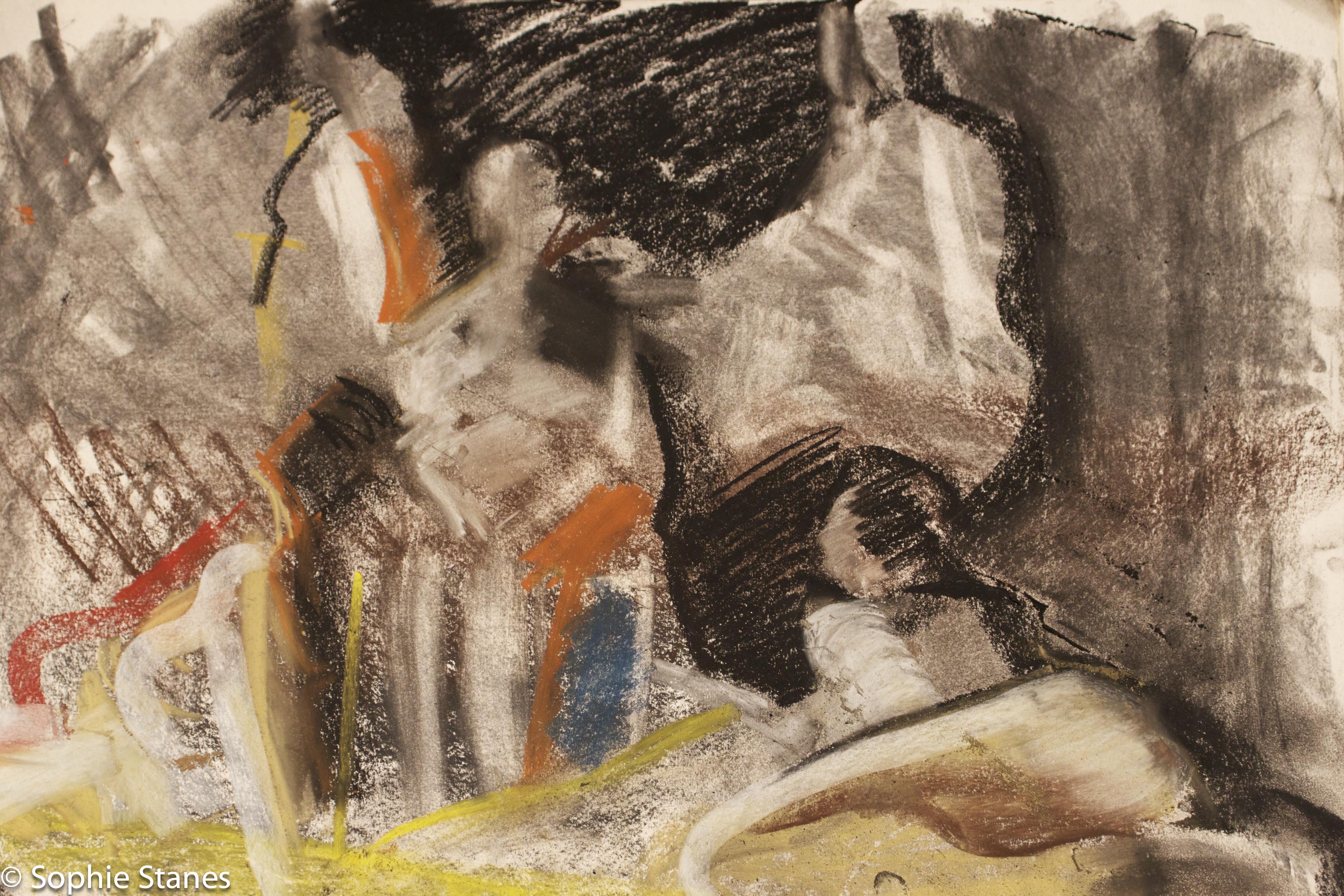
Drawing by Kate Hardy. Photograph by Sophie Stanes.

Drawing by Kate Hardy. Photograph by Sophie Stanes.

So that was one benefit of the life drawing session. The second was the way I was looking at the women. I wasn’t sizing them up or comparing their shape and appearance to mine. I wasn’t judging who came out on top in the thinness and beauty stakes. And I wasn’t using what I saw to beat myself up for my own imperfections.

Instead, I was seeing a work of art – the female form in all its voluptuousness and diversity – and I was trying to capture it on my paper. The models before us were an eclectic mix of shapes and sizes – young and old, thin and curvaceous, with large thighs and small, breasts that stood up or sagged and one lady, a breast cancer survivor and a veteran model, with only one breast. In between poses, these ladies talked about why they’d got into nude modelling – some had done so to restore their confidence after being in relationships with abusive men, some said modelling had taught them to love their imperfect bodies, it had given another a good reason to get out of the house.

As I heard their stories and drew their bodies, my own efforts to conform most of my life to a certain shape and size seemed foolish. We could never all look the same even if we tried – and why on earth would we want to? Our bodies are beautiful, in whatever form.

Then came the fun part. Following a call for volunteers to try nude modelling, a friend and I stepped forward. We’d both struggled with eating disorders and body image issues over the years and we were fed up with all the hiding and self-criticism. It was time to display our own works of art. Of course, we couldn’t do so without a little bit of slapstick humour.

“Hon, our boobs are touching,” I giggled as we stood stark naked, my arm across her shoulder and hers on my waist alongside a handful of other nudes, staring out to the room full of female life drawers and trying to keep a straight face. “I know, move that way a little,” she giggled back.

“I’m going to have to move – I’m all sweaty and my leg’s killing me,” my friend whispered half-way through the pose. “Mine too,” I answered as I quickly shifted my weight from one leg to the other and back again. With a few more giggles and some jiggling about, we managed to hold on until our time was up, returning to our clothes with – I reckon – a sense of pride for what we had done and a greater sense of freedom and acceptance for the varied and beautiful female form.

When I saw the drawings other ladies had done of our pose, it didn’t bother me (as it might have done in the past) that in some pictures I looked more stocky than I’d have liked to or not as pretty as I’d hoped. This was art and we had been works of art, open to interpretation. In fact, we are all works of art, both on the outside and on the inside. It’s good to remember.

So congratulations to Spirited Bodies for the brilliant work it’s doing – helping women people appreciate the way they look and to find confidence in their beauty. While I’m sad to say I didn’t keep my own drawings from that day or take any photographs of them, I have been looking for a life drawing class to join – as an artist not a model – and I’m excited about recapturing that sense of mental peace, concentration and appreciation of beauty that I remember from that Saturday at WOW.

Happy Easter!

Posted in Creativity, Eating disorders, Leisure, Self-Acceptance, Women | Tagged , , , , , , , | 11 Comments

What’s your role?

Before I plunge into today’s blog topic – What’s your role? – a quick plug for the Women of the World (WOW) festival that’s on at London’s Southbank Centre tomorrow, Saturday and Sunday. I was at WOW 2012 and loved every minute of it.

Last year, I spoke on a panel about body image and ageing and tomorrow, I’ll be on a panel entitled ‘Crash and Burn’ – discussing what happens when your life hits the wall, alongside Rosie Boycott, a recovering alcoholic, and the American comedian Ruby Wax (@RubyWax), who’s battled what she calls the tsunami of all depressions. It might not sound the most cheery of events but I hope we can bring some light to a topic that too often lurks in the shadows – and Ruby is guaranteed to bring us some laughs.

I haven’t thought about what to say yet but I’ll talk about my eating disorder, about what happens when we bottle up pain and difficult emotions and carry them from our childhoods into our adult lives – only to see them come out sideways in the form of compulsive behaviours. About finding myself on my knees in my bedroom late one night, some five years ago, asking ‘What’s the point?’. And about finding a way out from addictive behaviours and recovering a sense of peace and purpose, which of course isn’t always present – as regular readers will know – but that’s there in much greater measure than it ever was before.

Tomorrow’s WOW event also coincides with International Women’s Day and if you can’t get to WOW, there’s bound to be some sort of celebration of womanhood near you.

While there are so many inspirational women out there who’ve led phenomenal lives, I’ve decided this year to champion the unsung heroines in our lives: the mothers, the aunts, the sisters, the godmothers, the friends, the mentors, the teachers and the carers who don’t make the headlines, but who work behind the scenes to make sure we have the support we need. I’ve chosen my auntie as my unsung heroine today and, although she doesn’t care much for publicity, I’ve taken the risk of blogging about her in Canada, on JustCharlee.com (@_JustCharlee): International Women’s Day: Championing Our Unsung Heroines. Maybe there’s an unsung heroine in your life you’d like to take your hat off to tomorrow.

Ok, so back to the question, ‘What’s your role?’ It occurred to me recently that while so much has changed in my life since I was in my teens and particularly over the past ten years, some things have barely changed.

My role when I was growing up was to be the ‘good girl’ and the ‘achiever’. I’m not saying anyone particularly gave me this role, but I intuited – from my surroundings and from the things I heard – that it was my job to do well at school, get good grades, go to university and have a good career. It was also my role not to rock the boat and to stay out of trouble.

I did very well at the ‘good girl’ and ‘achiever’ roles – less well at staying out of trouble, although I guess the trouble I got into was more internal than external – self-harming behaviours like binge-eating and binge-drinking – and I also did a very good job at keeping my trouble to myself. Nobody saw past the good girl façade.

I also knew, or thought I knew, what my role wasn’t – it wasn’t to have boyfriends when I was growing up (although I did) or attach myself to a man. And it definitely wasn’t to depend on a guy for anything.

I remember introducing guys to my Dad when I was young, or perhaps I should say ‘guy’ because I think he only met one. I never brought boys home (or to his home, because that was different to mine) but I do recall a very awkward moment bumping into my Dad down by the River Mersey in Liverpool when I was with a guy I was semi-dating (I think I only did ‘semi’ back them – in fact, yikes, I think I only do ‘semi’ these days too!).

Dad wasn’t particularly interested to know who he was or what I thought of him – neither in the moment, nor later on, or at least that’s how I interpreted the scene. I don’t blame him for my single status or relationship difficulties – a lot of water has passed under the bridge since then – but I definitely took some pretty powerful messages on board around the value – or lack of it – of having a man in my life.

And it seems those messages don’t budge easily – they take some dislodging.

On the other hand, when it came to ‘A’ grades, places at Oxford Uni or sports’ trophies, Dad was very impressed. So I obliged by coming home with less boys and more ‘A’s. That was 25 years ago (oh my goodness, how old?) but even though I’m a grown woman and my Dad has been dead seven years, how much has actually changed?

I mention this because I’ve become acutely aware in recent weeks of the kind of news I’ve been communicating with family and friends – and it’s not too dissimilar to my teenage years. “Guess what?” I tell my brother, mum or auntie over the phone. “I’ve got a full-page article in The Sunday Times” or “I’ll be on ITV Daybreak in the morning or Newsnight later on.” Texts to my friends say similar things – “On my way to the BBC studios” or “Story in The Guardian today” (don’t worry, I also send them texts to say ‘Hi’, to meet up for laughs or to report my latest dating disaster).

But the point is I don’t remember ever making an excited call home saying, “Guess what? I’ve got a boyfriend” or “I’m moving in with him” or “You’ll soon be hearing the patter of tiny feet” (hopefully the news of the boyfriend would have been delivered first). If I’ve had relationship news to impart, I’ve done this in slightly embarrassed tones and as a bit of an afterthought, whereas I’m quite happy to shout my professional achievements from the tallest building.

A week away from my 42nd birthday, I reckon this is pretty sad. And I also reckon it’s time to change.

The ratio of messages I deliver about work and relationships also reflects the time I put into both – that is, work takes the lion’s share while you could count the hours I spend developing relationships with men or lining up dates on one hand (although that wouldn’t include the large amount of time I spend ‘working on myself’, which is arguably a vital stepping stone).

My subscription to the online dating site Guardian Soulmates has just lapsed and I’m embarrassed to say that over the course of some eight months, I went on two dates and chatted online to about four other possibles. And I never got round to getting a good picture up there – the first one was pretty old and then I swapped it for a picture of me in a pink woolly hat (a cute one all the same but honestly!) and then felt the need to assure any visitors to my page that I did actually have hair.

Of course, the cynic in me (or is it the realist?) puts my lack of online success down to my age. I’m not the first woman to note that describing yourself as 41, without children and maybe – repeat maybe – wanting them is a recipe for an empty inbox. And plenty of men I’ve interviewed for my book have told me, in the nicest possible terms, that of course they’d steer clear of the older model – and particularly women whose fertility might be challenged by their age – if there are younger ones on the market. The guys often don’t know if they want kids either, but you can’t blame them wanting to keep their options open and give a relationship time to blossom before having to raise the kiddy question.

So where do we go from here? Well, I guess I’d best get myself on an online site again if I’d like a date this year. And I’ve finally got a reasonable photo in the pipeline. Recent efforts to meet people out and about have proved rather unsuccessful (aside from the Mexican holiday romance, of course). A night out on the London Eye with a bunch of fellow singletons – dubbed by the organisers as the crème de la crème of the capital’s single scene – was a resolute disaster as the title of this Telegraph piece suggests: Dating on the London Eye: From life drawing to angry rabbits. I won’t tell you the whole sorry tale but suffice it to say that standing in a cold, dank, underground tunnel for 40 minutes with a bunch of men and women half my age who were swigging from cans of lager and vodka bottles – just to get our tickets to the next cold queue – is not my idea of romance. If that’s the crème, the cat can have it.

A night out at a Valentine’s barn dance – otherwise known as a ceilidh – with a bunch of girlfriends proved a lot more fun but was just as unsuccessful on the dating front as the ‘Wheel of Date’ – or as we renamed it the ‘Wheel of Death’. There were far more girls than boys. Still, we got to swing each other around on the dance floor and jig the night away.

If anyone has any great ideas as to what a successful, attractive single or SAS (as I believe we’ve become known) is to do to have fun and, at the same time, mingle with the opposite sex, I’d love to hear from you. Or come and join you.

In the meantime, I’ll be spending the next few days in an environment virtually guaranteed to be a man-free zone, bar a few brave types. Oh yes, and Gordon Brown. You might think this isn’t the best tactic given what I’ve just written but on this occasion, the laughs, the friendship and the female fellowship more than make up for it.

WOW 2013 will celebrate womanhood at its best and there are panels on pretty much everything, from female activism to pornography to life drawing to women in the media (love the title of this one: Sum of their body parts?). There’s also a panel on Saturday that’ll ask whether there’s a taboo around childless women, So you don’t have kids: Now what? and Jody Day of Gateway Women (@gatewaywomen) will give a talk on how to create a meaningful life without children on Sunday. All that plus comedy, music and guaranteed giggles.

So ladies – and gentlemen (yes, you’re more than welcome), come on down to WOW 2013.

Posted in Addiction, Dating, Eating disorders, Relationships, Uncategorized, Women | Tagged , , , , , , , , , , , , , | 2 Comments

It all started here

‘Maybe No Baby’ is the headline of a feature I wrote for The Sunday Times today on infertility and childlessness, particularly among women of my generation, late 30s, early 40s, and the difficulties of meeting eligible partners. It’s on page 20 of the newspaper if you have it to hand, or online, but behind a paywall so you have to be a subscriber to read it. Before I go any further, I should mention that I don’t get to choose the headlines, subheads or graphics/photographs and I’m very aware those used on this article might seem insensitive to women and men who are struggling with infertility or are childless, but not by choice. Hopefully, if you’ve met me or have read my blog, you’ll know I’m very much aware of the sensitivities around these issues.

Right now, after seeing the feature myself in black and white, I feel a little exposed and rather codependent – aware of the potential for being judged, as a writer/journalist, and very responsible for the feelings of all those people I interviewed for the piece. It’s really challenging to give everybody the space to speak and to cover all aspects of a topic when you’re writing to deadline and with limited space. As usual, I question whether I’m tough enough to be in this profession, but I continue to feel compelled to write.

At the same time, though, I’m doing my best to muster up some gratitude for everything that’s happened this week and some pride in my work, particularly for pulling together a well-researched 1900-word story for the Times in 24 hours.

I’ve been wanting to write about these issues in The Times, The Sunday Times or The Guardian for a good while and my determination finally paid off. I was also delighted to be asked onto Newsnight on Wednesday night to discuss IVF, late motherhood and childlessness. If you want to watch it, you can fast forward to the fertility feature, which starts around 36.15 (minutes), although it’ll only be on iPlayer for a few more days. It was quite a surreal moment, sitting there with Gavin Esler and Mariella Frostrup on one of my favourite news programmes, discussing a subject that’s very much close to my heart and referring to the book I’m writing – a book that was little more than a vague idea about eight months ago.

Of course, the irony of my situation hasn’t escaped me: I was at my computer until gone midnight on Friday night, checking over edits on the story, rather than out salsa dancing. And I was too shattered to get up to much fun for the rest of the weekend. So here I am, working hard on stories about singleness, the difficulties in meeting eligible men and post-40 childlessness, while I should probably be out there socialising. The key, of course, is that elusive thing called BALANCE. I’ll try and find some of that this week.

The main point I wanted to make about all this, though, is that it all started here, on this blog, at the moment I decided to trust myself to write about things I really care about and to put myself out there with my heart on my sleeve. It’s been a bit of a rollercoaster journey and I’m sure there are many ups and downs to come, but I can see now I was always moving in the right direction.

So if you’ve got an idea for something – a book, a business, an adventure – but that little voice in your head is saying to you, ‘who do you think you are? that’s a ridiculous idea, it’ll never work out’, I reckon you should just go for it and see what happens. You might surprise yourself.

Posted in Fertility, Pregnancy, Relationships, Uncategorized, Women | Tagged , , , , , , , , , | 1 Comment

Tiny feet

Following on from my Huffington Post piece on feminism and the large number of women in their late 30s and early 40s who are facing the prospect of childlessness, without feeling they made a conscious choice, I wrote something for The Guardian Comment is Free site today on a related topic: IVF for women over 40 doesn’t address the root of the problem.

The patter of tiny feet?

The patter of tiny feet?

Today’s piece was on the back of new guidelines recommending the NHS pay for one round of IVF for women aged 40-42 (the previous cut-off age was 39). I only had 600 words so it was difficult to get the whole message across, but I thought I’d written it in quite a balanced way – although you wouldn’t have thought so from some of the comments.

It’s a complex and sensitive topic and difficult to cover in a short blog. We all have our own personal circumstances – we are all products of our upbringing and we all digested the societal and cultural influences around us in different ways. We all had our journeys.

But there does seem to be a growing number of women of my age who are wondering what their futures will hold as regards children. As I try to make clear, when I get the chance, most of us don’t want ‘instant babies’. Some of us don’t even know if we want children or not. What we would like is the opportunity to date without the pressure of the biological clock, to explore a relationship with someone and then to decide, as part of a stable partnership, whether we want children or not, and how we want to go about that.

Of course, we are all different and there are women who have decided a child is more important to them than a partner and have taken motherhood into their own hands – solo adoption, visiting a sperm bank or co-parenting, for example. I respect and admire them for doing that but it is not a path I can imagine taking (although never say never). For me, a partner is more important than children and adoption is always an option I would consider if we – my future partner and I – wanted to go down the children route and that wasn’t possible naturally.

No doubt I’ll be writing more on this topic shortly (I have a more personal post I am working on), but before that, I’ll be discussing today’s revised NHS fertility guidelines and the issue of childless working women on BBC Newsnight tonight, if you fancy tuning in.

It’s a great opportunity to raise the profile of this issue but right now, I’m sorry to say, all I can think about is what to wear – and will I look fat. I realise those kinds of thoughts and feelings aren’t much of a triumph for feminism or women’s lib but I can’t help how my head works and it’s hard to change the habits of a lifetime. But I can fight back. Or at least surrender.

So, with a deep breath, I’m off to explore my wardrobe and have a bath …

Posted in Women | Tagged , , , , , , , , , | 5 Comments

Feminism, 50 years on

Today’s blog comes to you via The Huffington Post and it marks the 50th anniversary of the publication of Betty Friedan’s The Feminine Mystique – a book, I have to confess, I’d barely even heard of until recently.

No, I definitely didn’t spend my formative years reading up on feminism and women’s lib like some other women my age. I wasn’t very politically aware – too many other things to worry about I guess: my body shape and size, how far I needed to run to burn off the consumed calories, whether people liked me or not.

I remember, when I was at university, stumbling upon a poll tax march in London one weekend. The march had turned into a riot, cars were on fire and there was broken glass everywhere. That was the first I’d heard about the violence. I’d been drinking beer in the sun with my university chums and watching the Oxford-Cambridge boat race. I did have an opinion about the poll tax and I do remember attending the odd march, but I guess I just wasn’t bothered enough to dedicate much time to the protest.

Or maybe, back then, I was politically apathetic because I was too unsure about myself to voice any opinions or even to trust myself to have any.

Well, I’m still pretty unsure about myself, especially when it comes to airing my opinions on public platforms, but I’m doing it all the same.

If you’d read this piece already via the Huff Post then I’m afraid to say there’s nothing new. If you hadn’t, then here it is – and your comments are very welcome. I’m working on a more personal follow-up but it’s not quite ready yet. In the meantime:

Fifty Years on From ‘The Feminine Mystique’, Now Childless Working Women Ask, ‘Is This All?’

Half a century after bored American housewives asked, “Is this all?” in Betty Friedan‘s groundbreaking book The Feminine Mystique, many professional women are asking the same question – but for very different reasons.

Swept along by feminism’s second wave, a movement ignited by Friedan’s work, women in their 30s and 40s who’ve fulfilled their intellectual potential and earned their independence are waking up to the fact they might also want children – and they’re wondering how on earth it all got so late.

As a 41-year-old, single female with an impressive CV, a passport full of stamps and a foot on the London property ladder, I am one of these women. And as a journalist who’s writing a book about the predicament of would-be mothers of a certain age, I’ve talked to women around the world who are in the same boat.

Don’t get me wrong: I, for one, am hugely grateful that Friedan and her contemporaries liberated us from the tyranny of the kitchen sink.

I imagine I might be experiencing what she called “the problem that has no name” – “a vague undefined wish for ‘something more'” – if I had never had the chance to work, although I respect women for whom homemaking has been enough.

I also agree with the columnists and bloggers who, in recent days, have noted that the battle for gender equality is by no means won.

But for those experiencing feminism’s unintended consequences – childless, working women of my generation who, just like Friedan’s housewives, are wondering if there’s ‘something more’ – it can feel like the pendulum swung too far the other way.

In Britain today, one in five women reaches their mid-40s without children, a rate that’s nearly double that of the previous generation and comparable to that of women born in 1920, whose main childbearing years fell during World War II. The statistics are similar in the United States.

For some women, this will be out of choice, but for many others it’s down to circumstance.

There’s also been a surge in women giving birth over 40, but statistics show it’s not going to work out for all of us, even with the miracles of science.

So today, women in their late 30s and 40s who might want children – particularly those who are single – face a whole different set of choices to those initially offered by women’s lib: do I freeze my eggs or have I left it too late? Do I date like my life depends on it – shaving five years off my age on my online profile so I don’t appear desperate?

Do I explore IVF, co-parenting or look into adoption and do I have the financial and emotional reserves to do so? Or do I accept motherhood might not happen to me and make peace with a potentially childfree/childless future (depending on how you look at it)?

Many women have put their hard-earned independence to good use by visiting a sperm bank or adopting on their own.

But for those of us who, for whatever reason, don’t want to go it alone, it’s the most traditional of options we worry is slipping out of reach: the chance to meet someone, spend time getting to know them – free from baby angst – and to decide, as part of a partnership, whether to try for children or not (‘try’ being the operative word, because of course we never know).

As one 39-year-old female doctor told me: “I want the ability to say ‘Yes’ or ‘No’, rather than have the choice taken away from me because I haven’t met the right person or I’ve run out of time or whatever.”

Some might say that as so-called ‘career women’ we made our beds so now we have to lie in them. The word ‘selfish’ is often bandied about. But none of us recall making a deliberate choice to put work before families.

We simply followed the suggestions of our parents, teachers and glossy magazines and seized the opportunities presented to us, opportunities that our mothers often hadn’t had.

We studied and worked hard, travelled the world and dated a string of inappropriate men (or was that last one just me?), never meeting anyone we wanted to settle down with or never feeling ready to commit. After all, we had plenty of time, right?

Ask any woman of my generation about the messages she heard when she was growing up and ‘make sure you plan for motherhood’ probably won’t feature.

But she’ll likely tell you she was encouraged to fulfil her potential and establish her independence. Maybe she heard she could “have it all”. And if her parents split up in the 1970s divorce boom like mine did, perhaps she was told never to depend on a man or not to bother with men at all.

Even in our mid-30s, often we were still building our careers and moving in childless circles. One friend recalls that at 35, she was thinking she still had years to get pregnant – instead, if you look at the statistics, her fertility had just dropped off a cliff.

And there was always IVF, we thought, sometimes without realising that the chances of conceiving via in-vitro also diminish drastically with age.

Then, in our late 30s or early 40s, we came up against a rapidly diminishing pool of potential partners. You only have to glance at an online dating site to see how things have got skewed – many men my age set the upper limit of their desired female partner at 38, if not younger, for understandable and slightly infuriating reasons. Like us, they don’t want an instant baby – but they do want the choice.

Of course, plenty of my school and university contemporaries had careers and children and they grew up in the same social context as me. So clearly there are individual reasons why women end up on the verge of missing the baby boat – mine include my parents’ divorce, addictions that flourished in my 20s and recovery from them that consumed much of my 30s.

But there are also societal and cultural reasons why there are so many women around my age who are wondering if it’s too late for biological motherhood, or who are grieving the fact they’ll never give birth.

Social movements, as experts note, often bring unintended consequences and it’s clear things are now balancing out.

From my conversations with women in their 20s, they’re aware they’ll need to plan for families if that’s what they want. The media is filled with stories of failed IVF cycles and the perils of late motherhood while enough women are talking publicly about their experiences around childlessness or the difficulties of finding a mate.

And, increasingly, thanks to women like Anne-Marie Slaughter, today’s professional women are also aware that combining high-level careers and motherhood requires painful compromises.

Hopefully, as we press on with the work begun by our feminist predecessors, societal expectations, government policies and workplace schedules will adapt to ensure more of us can have careers and families before time runs out – so in the future large numbers of women won’t end up childless without having made the choice.

Posted in Pregnancy, Women, Work | Tagged , , , , , , , , , , , | 3 Comments