Where there’s a will

Where there’s a will, there’s a way.

This old English proverb is relevant, not just because I’ve recently written my will (don’t worry – I’m not intending on going anywhere soon), but because my recent sadness and the fact that it seems to have lifted (at least it had on Sunday and Monday, today I’m not so sure) has reminded me of some of my better qualities: persistence, determination and the flicker of hope that seems to be always there, despite the bouts of glumness.

So I did write my will last week. I was taking advantage of an online half-price offer and the company of a friend who was getting hers out of the way too before the deal ran out. We sat together, at my kitchen table, discussing who we were going to leave our ‘estates’ to and playing each other songs we’d chosen for our funerals from iTunes or YouTube.

If I was a comedy sketch writer, I’d have some great material. “I’ve gone for cremation”. “Me too”. “I’m donating all my body parts for research and transplant”. “Research AND transplant? Well, yes, why not both? Me too”. Interspersed with various hymns, pop, rock, soul and gospel songs.

I was a little unsure about where I wanted my ashes scattered, torn between the ladies pond on Hampstead Heath (near it, not in it!) and the River Mersey, but I’ve plumped for the latter. Nothing quite beats going back to your roots. And writing that, it’s just occurred to me that “Going back to my roots” would have made the perfect funeral track:

“Zippin’ up my boots, Goin’ back to my roots, Yeah, Take the place of my birth, Back down to earth … “

Why didn’t I think of that last week? I’m going to have to redo the will to update the playlist. It’s fun to think of my pals dancing their way out of the church, singing “Zippin’ up my boots … ” (So if I don’t manage to amend it, take this blog as a final request re song choices!). Of course, I also hope I’ll have a better reason to update the will at some stage. It’d be nice to think I’ll have a partner and/or children to share my spoils with a few years down the line. As things stand, my mum, brother and nephews stand to do pretty well.

In the meantime, however, my affairs are in order, and that gives me a bit of peace and a sense that I’m taking responsibility. The process also reminded me of a passage I read in a book a while ago. The author talked about imagining one’s own funeral, who would speak, what people would say, how you wanted to be remembered and what for. It’s designed to get you thinking, to value the important things in life and to prioritise them. I’m not sure it worked for me.

On the subject of death, just briefly, before I move on from the morbid stuff to talk about busyness and anxiety (!), I was finishing Caitlin Moran’s ‘How to be a Woman’ book last night and she was talking about death. She says death focuses the mind: “It makes you love vividly, work intensely, and realise that, in the scheme of things, you really don’t have time to sit on the sofa in your pants watching Homes Under the Hammer.” I’ve never watched Homes Under the Hammer and I never put the TV on before 6 pm, a norm I inherited from my mother – with Wimbledon being the only exception – but I definitely haven’t got this ‘seize the day’ thing sorted. I don’t live as though this was my last day on earth, I do idle away time, procrastinate and watch rubbish TV. And while I’d like to be able to say I never waste my days, it has to be OK to take it easy, to sit back, rest, read, and watch some rubbish TV, now and then.

Yesterday was a case in point. I had an easy, non-stressful, non-pressured day in which I achieved very little but I felt content throughout the day and went to bed feeling grateful and at peace with myself, rather than stressed and miserable. I went for a long swim, jacuzzi and steam, did some grocery shopping, watched some Wimbledon, sent a few emails, spoke to a friend, did a bit of thinking/planning and some reading. Actually, when I put it in one sentence, it sounds like quite a busy day. But I have very few days like that – when I don’t achieve or strive or try to achieve or strive or think about achieving or striving. I had twinges of guilt throughout the day but I let them come and go. And as I saw them off and curled up on the sofa with a magazine, Wimbledon playing on the TV in the background, I smiled. Finally, I thought, contentment.

Which brings me on to an excellent article, a New York Times blog, which I hope you have time to read all the way through: The ‘Busy’ Trap by author Tim Kreider. He must have read my mind before he penned that blog. I couldn’t have said it better myself. How many times have I answered “I’m busy, really busy, crazy busy” when someone has asked me how I’m doing? Too many to remember. I let out a sigh just thinking about it.

Kreider writes that many people are addicted to being busy and “dread what they might have to face in its absence.” His description of a female friend who’d moved to France – and who was working less, socialising more and had a boyfriend – particularly spoke to me: “What she had mistakenly assumed was her personality – driven, cranky, anxious and sad – turned out to be a deformative effect of her environment.” I hear the sound of bells ringing. He goes on to say: “Busyness serves as a kind of existential reassurance, a hedge against emptiness; obviously your life cannot possibly be silly or trivial or meaningless if you are so busy, completely booked, in demand every hour of the day.” More bells ringing.

I guess this has got a lot to do with my recent sadness. I was incredibly busy from March until late June, working all week, some evenings and some weekends, juggling jobs and projects, alongside my perfectionism and procrastination – not easy. Then I went away for a week, worked with a team and lived in community. And then it all stopped. My decks became clearer (they’re never completely clear). I slowed down. I lost the “existential reassurance” I was getting from busyness. I lost my “hedge against emptiness”. And I stood staring the emptiness in the face. Scary. But it has to be done. And maybe the more I do it, the easier it gets.

And I promise the next blog post will be cheery!

Posted in Addiction, Happiness, Leisure, Uncategorized, Work | Tagged , , , , , , | Leave a comment

Somebody to love

When I looked at my last blog post just now, I felt sad – and not just because it was entitled ‘A space for sadness’. It’s dated June 5th. Twenty-one days ago. Three weeks.

That would be fine if I’d been on holiday or had decided to take a break from blogging. But I haven’t written here because I’ve been busy working on other stuff – stuff that’s less creative, less fulfilling and much further from my heart than this blog and what it represents. Because this site, to me, is more than just a pretty, flowered Internet page with a collection of random musings – it’s a platform to work through, understand and express what’s really going on inside me and to do the kind of writing I find fulfilling, rewarding, pleasurable and that I believe has the potential to be of service to others.

So it’s no wonder I feel a little sad that I haven’t found time to blog. But then it’s also true (as some of my lovely readers have gently pointed out) that I’m prone to give myself a hard time for everything I do or don’t do: whether I write too much or too little, whether I do too much paid work or too little, whether I spend too much money or too little. It seems, when it comes to my evaluation of myself, I can’t win. So at this point, I’ll let myself off the hook for the choices I’ve made in the past few weeks. There’s no right or wrong, only learning experiences and opportunities for growth.

When I last blogged, I was feeling a different kind of sadness. I’m pleased to say that sadness lifted – but then it returned. And then it lifted again. Right now, I’m not quite sure where it is. I think it’s probably hovering above me, a little uncertain about whether to hang around for a bit longer or move on, until it’s time for its next visit. But its coming and going reminds me that feelings pass, if I let them. Unfortunately, that seems to hold true for the good feelings as well as the bad.

My more recent feelings of sadness have been to do with loneliness. In fact, that’s probably what I was sad about in the first place. It’s probably what I’ve always been sad about. But I’m very adept at disguising the true source of my sadness with various diversionary tactics: I work too hard and don’t have enough fun and think that’s why I’m sad. I worry about my finances and my future and think that’s why I’m sad. When actually, it’s all part of the distraction. It seems I’m trying to hide the root of my sadness from myself, because I think it’s going to be too painful to look at. But these days I’m not able to last very long. The truth generally comes out, despite my resistance.

So, loneliness. Emily White has written a book about it, called Lonely: Learning to Live With Solitude. I haven’t read it yet but I’ve read a little of her blog and I imagine there’s a lot in the book I could relate to.

It took a week spent living and working with colleagues in a close-knit community (I was doing some media training with the Armed Forces last week) to realise just how lonely I was. As I dragged my suitcase through Paddington Station, along Tube platforms and up my dark street to the door of my empty flat at the end of my week away, the tears started to fall. They began gently as I sat surrounded by strangers in half-empty Tube carriages but by the time I got off my last train and walked up my road, they were falling fast.

My feelings of loneliness were exacerbated by the fact that pretty much all of my colleagues from that week were driving home in their cosy cars with their music playing to husbands, boyfriends, partners, fiancées or children. Of course, that doesn’t mean to say they weren’t feeling lonely too. I do have a tendency to compare my insides with other people’s outsides – to assume that just because people are partnered up or have offspring that all is rosy in their lives. I know, in my head, that’s not true. I know it’s just as possible to be lonely in a relationship than out of one. But my heart often takes over and I assume I’m the only one who’s alone or who feels sad.

Those tears triggered a torrent of thoughts: it’s time to leave London, to move back to the Northwest, to be closer to my family, to a cheaper lifestyle where I can afford a car (somehow owning a car represents grown-upness, freedom and companionship all at once – maybe it reminds me of when I was living in Mexico and felt part of a very close family of friends who’d go on adventures together, all packed into my trusty Golf).

The tears also sparked thoughts of changing my career to do something less solitary than journalism and writing – the idea of teaching grew in attractiveness. These are valid thoughts. They are not off-the-wall ideas. Maybe it is time for a change. But I know I take myself with me wherever I go and a new town or career won’t necessarily change how I feel.

So how do I feel? Well, as I texted to a friend on Saturday, I feel like I’ve got a big hole inside me that’s never been filled. And God knows I’ve tried: food, exercise, body obsession, achievement, busyness, alcohol, men, anxiety and worry. The list of fillers goes on, but none of them provided the stuffing I was looking for. The hole goes deep and dates back many years. Maybe I’ve always felt lonely. Maybe I’ve felt incomplete since I was very young, like a part of me was missing.

I’ve also realised, through this period of sadness, that I have a rather warped idea of love and relationship. Recently, I’ve heard a number of men talking about getting engaged or married. It always confounds me. It seems I’m surprised that men would want to commit to spending their lives with a woman, with all that entails, or at least in my mind: the compromise and the loss of freedom. Why would anyone want to do that? Looking at it now in print, it seems like a very odd question but I appear to have a fundamental notion that people must be crazy to want to spend their lives in partnership with someone else.

Breaking that down, I obviously think that any man must be crazy to want to spend his life in partnership with me and that, equally, I’d be foolish to want to give up my independence and commit to a relationship. I’m now seeing how deeply ingrained these warped ideas are. The message I took away from my childhood is that you’re better off on your own and relationships don’t work. It’s sad to think one of my favourite songs until recently was Paul Simon’s ‘I am a rock. I am an island’ – the lyrics really spoke to me.

It’s sad because that treasured ‘island’ status, that fierce independence and that rejection of partnership is what, in part, has fed the loneliness.

I say in part because I realise that a boyfriend/partner/husband isn’t going to be the antidote to loneliness. I’m sure it would help to have a companion – studies show that those who aren’t in a relationship are more prone to depression – but it won’t be the missing piece of the jigsaw that I’m looking for, just like a fulfilling career, faith in God, fun and good friends won’t provide the missing piece either, not on their own.

I’m coming to understand that, at least for me, there isn’t just one missing jigsaw piece – there are many small pieces that combine to fill the hole. They might include relationships with God, myself, a partner, friends as well as fulfilling work and fun, relaxing times. If you stuck them together to make one big piece, you could call it LOVE. But I think I need to add another piece that might be called ACCEPTANCE – acceptance that the hole might never be completely filled, that there’ll always be a small piece of the jigsaw missing, that there’ll be times when I still feel lonely, despite feeling loved, safe, secure and fulfilled. Perhaps if I can accept that and stop worrying there’s something wrong with me, I can get on with the business of living and loving without always trying to fix myself or find the missing piece of the jigsaw. The prospect is quite liberating.

At this point, I have to ask myself a number of questions: Do I think too much? Do other people feel like there’s something missing and wonder what it is? Do they feel complete or do they just get on with life without pondering what that missing jigsaw piece could be? From the books I’ve read in recent months, I’m not necessarily alone (although perhaps I do think too much!).

I’m currently reading Jeanette Winterson’s ‘Why Be Happy When You Could Be Normal?‘ after it was recommended by a friend. I’m half way through but have already found it very moving, particularly the author’s honesty about her own relationship with love. In one passage, Jeanette says that children who are neglected in some way can’t grow up. “They can get older but they can’t grow up. That takes love. If you are lucky the love will come later. If you are lucky you won’t hit love in the face.”

I think I’ve hit love in the face before, or maybe I’ve never got that close. Maybe I walked away before I was even within arm’s reach. I’d really like to change that. Because I do believe love has the capacity to heal. Which is why I’ve adopted an affirmation I heard a lovely lady say a few weeks ago. I hope she doesn’t mind me borrowing it and repeating it here:

“I am open to receiving love that heals my heart and makes my spirit sing.”

I’ve been saying it and I will continue to say it until I am open, until my desire for love, for true companionship overrides the deep hurts that put obstacles in love’s path: the fear of commitment, the fault-finding, the lack of acceptance of myself and others and the futile search for something, for somebody that doesn’t exist.

In the meantime, though, I can get on with loving those people who are already in my life and available to be loved: my family and my friends. Oh yes, and myself. That’s a very good place to start.

I’ll let the late Freddie Mercury close this blog, with a rendition of ‘Somebody to Love’:


Posted in codependency, Happiness, Love, Relationships, Self-Acceptance, Uncategorized, Women | Tagged , , , , , , , , | 8 Comments

A space for sadness

Over the last few weeks, since my previous blog post, I’ve felt a lot of sadness. The tears have been flowing with a frequency I haven’t experienced in quite a while. I always find this worrying. Is there something seriously wrong with me? Am I depressed? Do I need medication? Will I always feel like this? And where does all that water come from anyway?

But once the panic dies down and I stop the catastrophising, I realise that it’s probably just another layer of the proverbial onion being peeled off and that the tears, most likely, are a good thing.

Emotional pain, going on previous experience, is a harbinger of change. The phrase ‘no pain, no gain’ comes to mind but that doesn’t quite cover it. Yes, there’s a lot to be gained from change but ‘gain’ suggests a short-term goal or a specific target whereas I’m talking about a much more fundamental shift.

It seems I’m being challenged to reassess my relationship to my work and to money, perhaps even to my identity – because my work is so bound up in my sense of self and has been since I was very young. I’m being asked to replace worry with trust, constant striving with letting go and the interminable drive to achieve with a sense of fulfilment, irrespective of results. I’m being prodded to follow my heart instead of my head or the next pay cheque.

It’s not going to be a simple task, which is why this particular layer of the onion isn’t peeling easily and why the process is accompanied by a fair amount of tears. This time, it might end up coming off in shreds rather than in one clean sweep.

Swimming with the ducks

Of course, these tears have probably been wanting to leak out for quite a while but it’s only when I give myself some space to feel – some space for sadness – that they’re able to surface. I found this space at the Kenwood Ladies’ Pond on Hampstead Heath last week during a sunny spell that, as I look out at the rain and feel the cool air through the open window of my studio, seems a very long time ago.

As is probably evident from my writing on this blog, I very rarely stop. If I’m not working then I’m pursuing some form of self-improvement activity, letting off steam playing team sports or tidying up after myself. There’s little time for pondering life, relaxing or lying down (other than sleep).

But just like my Mum, whose deep tan suggests she lives on the Costa del Sol rather than in Wales, I’ve never been able to resist a bit of sunshine so I spent one glorious afternoon and an even more glorious evening at the pond – and felt moved to blog about it for the Huffington Post: Swimming With the Ducks – Finding Peace at Kenwood Ladies’ Pond. It was that time of stillness and quiet, that opportunity to lie motionless, soak up the sun and feel close to Nature, that opened the floodgates to the tears.

My choice of reading material no doubt also contributed to my mood and prompted the tears to flow. I was reading Sally Brampton‘s extraordinarily honest memoir of her depression, Shoot the Damn Dog, and couldn’t help but be moved by her account of her breakdown, her relationship with her daughter and her mother and her battle with addictive behaviours. It triggered a lot of feelings about my own family relationships, my history and my struggle with self-harm, particularly around food. It put me in touch with my own sadness.

Tom Jones at sunset in Hyde Park

And that sadness has stayed with me, despite my best efforts to join in with the Queen’s Diamond Jubilee festivities. That doesn’t mean I didn’t have fun watching the flotilla down the Thames from a friend’s house boat or singing along with Tom Jones, Paul McCartney and Jessie J at the Diamond Jubilee concert – watching on a big screen in Hyde Park with lots of other flag-wavers. The concert, along with a gig I went to on Friday night, reminded me that music and dancing really do revive me and shift my mood and that I’d like more music – particularly the live version – in my life.

But the sadness has been ever present and I’ve sometimes felt I’ve been some sort of passive observer of my life, having a kind of out of body experience, looking down at myself and asking, ‘Are you really having fun?’ or ‘How come you’re not having as much fun as everyone else?’ Yes, I agree, I think too much.

The good thing is, though, that I know today it’s OK to be sad and the sadness will pass. I don’t have to push myself to have fun or change the way I feel. I don’t have to eat on it, drink on it, over-work on it, or obsess about men to get rid of it.

The sadness can stay. And when it’s ready to go, it’ll go.


Posted in Addiction, Happiness, Self-Acceptance, Spirituality, Women, Work | Tagged , , , , , | 6 Comments

Abundance

It’s been over two weeks since I wrote on this blog, which is a sure sign that something is out of kilter. Having time to blog generally means my life is well balanced – that everything is in its rightful place, that I’m making enough space for creativity, for my visions and dreams, alongside the work that pays the bills.

But in the past few weeks, the work that pays the bills has hijacked most of my time. Why is that? The answer has very little to do with money. Doing the work that pays the bills – the work that’s always paid the bills – is a lot easier, a lot less scary and carries a much lower risk of rejection than the more creative projects that require me to stretch myself, to try something new and to expose myself to being ignored or dismissed.

In fact, I’m so confident of being accepted and praised when I do the work that’s always paid the bills that the pull is incredibly strong, almost irresistible. But why do I keep craving acceptance and praise? When will it be enough? Why this need to prove myself in something I’ve already proved myself in? And when will I be able to walk away from the comfort zone of guaranteed acceptance and praise and walk into the unknown territory where, I believe, my creativity sits waiting to be tapped and where fulfilment lies?

As is often the case, it comes down to fear. It’s no surprise that so many of us stick to what we know, to what we know we’re good at, to what we know will pay the bills and bring us acceptance. This will particularly be the case for those of us who so desperately crave a feeling of safety and acceptance because we spent so many years feeling unsafe, exposed, insecure or unacceptable.

But what I’ve noticed in the past few years about my own sense of safety and security is that it has very little to do with externals. I can own my own flat, earn a decent wage and have a little bit of savings, but possessions and a healthy bank account seem to make very little difference to my sense of security. I construct walls around myself, grabbing at bricks and mortar wherever I see them, adding turrets and spikes, but those walls never feel high or robust enough. I’m trying to create something on the outside that can only be built from the inside.

This feeling of insecurity, particularly financial insecurity, isn’t surprising. When you grow up with a sense that there isn’t enough and there’ll never be enough, those thoughts stay with you and are difficult to shake. In fact, as any good psychologist will tell you, many of us even go out of our way to recreate the conditions of our infancy. Just as a woman who was abandoned as a child by her father is often attracted to men who’ll abandon her, or a man who’s mother was controlling seeks out controlling women, those of us who were brought up with a sense of impending financial doom will recreate that pattern in our adult lives. We’re drawn to what we’ve always known, until we’re brave enough to break the cycle and walk free.

I’ve never felt I deserved an abundant life. I always thought it’d be a struggle, that things wouldn’t come easy, that happiness was elusive and that it was all a bit of a slog. And because that’s what I expected from life, I’ve often created those very conditions or found ways to reinforce those core beliefs. I’ve rarely taken the easy way out, often opting for the hardest route, and I’ve never really felt that success, fulfilment or joy were mine for the taking.

Those beliefs have manifested themselves in a number of ways. No matter what salary I was earning, I lived for years in a state of vagueness around my finances, not really knowing whether I had enough. This was pretty easy to do as an ex-pat living on a dollar salary in Brazil or Mexico – budgeting wasn’t necessary. But living in London for the past decade has been a different story.

A few years ago, it dawned on me that I had to take charge of my finances and I made an attempt to track my incomings and outgoings, but I never really got the hang of it. Then when I became self-employed, the vagueness set back in. I’ve booked holidays without knowing whether I could really afford them so I’ve spent my time abroad worrying about how much I was spending. I’ve stayed out of clothes shops for months but then splurged on three expensive dresses. I haven’t put money aside for taxes or known how much I’ve owed until it was time to pay. Yes, I’ve got by and there has always been enough, but I haven’t enjoyed it. I’ve been living in a state of anxiety around my money and my ability to support myself – very similar to the one I grew up in. I’ve recreated the conditions of my past, conditions I’m familiar and comfortable with.

Of course, this state of vagueness has also fuelled the ‘knight in shining armour’ fantasy. You know the one. Although deep down I know I can support myself – I’ve been doing so since I was 18 – the cloud of financial insecurity that hovers over me means I’m always secretly hoping I’ll meet a man with a few pennies in the bank, who’ll take charge of all the finances and take the pressure off. I’m ashamed to admit I was still hoping to be rescued. (Will I ever get a date again?!).

But I say ‘was’ because, I’m pleased to say, things are changing. No more vagueness about my finances, no more living in a state of financial unease. Thanks to my favourite new iPhone App, My Weekly Budget, I’m tracking everything I spend and I’ve listed all my outgoings on a pretty spreadsheet. For me, this is a real sign of maturity. I realise I could have learned all this stuff a long time ago – I think they should teach basic budgeting in schools, if they haven’t already started – but until recently I was quite happy to live with financial anxiety because it’s all I’d ever known.

Of course, the other half of the equation is to increase my earnings and to believe I truly deserve abundance, fulfilment and joy. Life doesn’t have to be a long, hard slog, overshadowed by a dark cloud of doom and gloom. But changing things is going to require courage. Believing we deserve to prosper in all areas of our lives means taking steps towards achieving that. It means saying No to some of the work that pays the bills and believing we can make a living from our true creativity, from work that delights and fulfils us.

For me, doing this is going to require baby steps. I know there are adventurous types out there who are willing to bet every last penny of their savings on their new business idea or take months off work to write a book. I don’t expect to change my deeply ingrained fear of financial insecurity overnight, so I’m going for the incremental approach – making small changes I can build on, slowly and steadily. A lot of other things will also need to come into play: better time management, more discipline (in a gentle sort of way) and less perfectionism.

But overall I think it comes down to boldness.

Abundance

Boldness to start working on a synopsis for my book and sending it out to agents – I emailed an agent with my book idea a few months ago, got good feedback although a negative response and I haven’t sent it anywhere since. I think there’s room for some boldness there! Boldness to cold call editors with my story proposals or to follow up on leads or ideas I have, rather than letting them go cold or peter out. And boldness to believe I deserve the best God and the universe have to offer. Life may never be a bed of roses, but there’s definitely room for a lot more flowers.

Posted in Creativity, Faith, Happiness, Self-Acceptance, Trust, Uncategorized, Women, Work | Tagged , , , , | 2 Comments

Staying alive

If you managed to read to the bottom of my last post, I congratulate and thank you. It was a long one. I realise blog posts are supposed to be short and I should probably be saving a lot of this writing for that book I keep talking about. But once the memory train has left the station it seems to hurtle on down the track, only coming to a halt when another appointment or deadline obliges me to wind up my writing.

I confess I cried as I blogged my Mexican memoir – when I wrote the line about my family likely not caring if I’d have returned home penniless and unemployed. I was so proud, so determined to achieve and impress and so reluctant to admit defeat or failure that I didn’t feel I could come home without a job or some amazing accomplishment. Of course, I can still be proud and reluctant to admit defeat but today I see how that façade, that lack of vulnerability blocks me from real relationship, from real connection with myself and others (more on that later).

That memory of sitting on the Mexican side of the Tijuana border crossing in my early 20s, watching my British travelling companions walking back to the States and bursting into tears as the extent of my aloneness hit me is a particularly vivid one. But then I did what so many of us do: I put my sadness, insecurity and fear in a little box, replaced it with a smile – and in my case with bravado and recklessness – and set off on the next leg of the adventure.

Since I wrote that post, I’ve been pondering what it was all about: the extreme risk-taking and the pattern of putting myself in dangerous situations. Did I have such a low opinion of myself that I didn’t think I was worth looking after? Did I actually want to get hurt? Or was I oblivious to the risks I was taking, seeing them as part and parcel of an adventurous, curious spirit? Was I naively trusting, or was I testing the boundaries to see how far I could push them without anything bad happening? Was it the adrenalin I was chasing? Perhaps it was a combination of all of those things, wrapped up in a sense of youthful invincibility.

One thing I do know about those ten years I was abroad – eight in Latin America – is that a lot of my activities, experiences and choices were based on a deep desire to feel alive. Hence the risk-taking and the highs from the sugar and alcohol, but also the healthier, exhilarating activities like exploring, dancing salsa, swimming in the wild ocean, water-skiing and singing very loudly to catchy pop tunes on glorious, sunny drives across Mexico or Brazil. I heard the Cher song ‘Strong Enough’ on the radio the day after writing my last post and it reminded me of a drive with a friend from Sao Paulo to Rio, via the beautiful town of Parati where we stopped to take a boat trip on the glistening waters. I challenge you to listen to it without tapping your foot or singing along:

But two questions remain: Why that urge to feel so intensely alive at any cost? And how to create that sense of aliveness today, as a 41-year-old woman living in drizzly London on a modest income, without getting into danger, returning to unhealthy habits or hurting others or myself?

The answer to the first question goes back a long way. The feelings I was running from were so low that I had to go high to avoid them, hence the anaesthetising behaviours that produced those highs: the binge eating, starving, over-exercising and over-working. That quest for aliveness was also a reaction to feeling stifled and blocked from real joy and freedom as a child. I wanted so desperately to fly but felt weighed down by worries and troubles that had no place on a young girl’s shoulders. Back then, the phrase ‘the only way out is through’ made no sense to me. Instead, the only way through those painful emotions was to circumvent them, to hurdle over them, to go to the opposite extreme.

That explains why I loved anything that gave a surge of emotion: the parachute and bungee jumps; the headiness of spinning around a dance floor to a live salsa band; the excitement of being pulled along on skiis by a speed boat and jumping across the wake; the exhilaration of swimming through the powerful Pacific waves and the sense of freedom from standing on top of ancient pyramids, trekking through rain forests, canoeing on the Amazon, swimming in rivers with crocodiles or jumping off high rocks into water.

Of course, exhilaration is all well and good but push that desire to feel deeply alive a little further and it’s no surprise you end up at the unhealthy, dangerous, addictive end of the spectrum.

Years later, the time comes when those crutches – the food, the drink, the compulsive drive for adrenalin, attention or achievement – stop working and you learn to put them down. Life, at first, seems rather dull and all the fear and insecurity you were masking with them bubbles up to the surface. Instead of being a daring risk-taker who dived through Pacific waves, you end up scared to put your toe in the waters.

You draw this line between the ‘old you’ and the ‘new you’ and life becomes about analysing why you did what you did and avoiding potential harm. You run away from anything associated with that old way of being, scared you’ll fall back into painful patterns. Add the British weather into the mix – rather than the sunny climes of Brazil or Mexico – and you start to wonder what life’s all about. Is this it? Wasn’t I better off riding the highs, irrespective of the dangers, rather than wandering around these grey flatlands? It’s little wonder people with addictive personalities fall off the wagon.

But the problem was we’d swapped one extreme for another. Eventually, we’d have to find the middle ground: that elusive place of balance.

And for me, given I can’t change my fundamental nature, that also means finding healthy highs. It means working out what I can salvage from that old life that isn’t harmful to my health or devastating to my self-esteem.

Fortunately, I’m discovering there are plenty of options. I still have dancing, singing, swimming, travelling, exploring, laughing and the adrenalin rush that comes from sport.  I can still go to the sun, water-ski, canoe, cycle, climb up mountains and abseil down them. I can still experience the thrill of new cultures.

If, that is, I can get myself there. Now those feelings of fear and insecurity roam freely, it’s a lot harder to make choices or be spontaneous. The ‘what ifs’ can hijack the whole process and before you know it, you haven’t taken a risk for years. That’s why, in this new life, I need different tools in my toolbox: faith, meditation, support from friends, greater self-esteem, more authenticity, trust in my true self and a growing awareness that it’s absolutely fine to make mistakes. Nothing ventured, nothing gained.

Along a similar theme, last night I heard author, columnist and agony aunt Sally Brampton speak at a Psychologies Magazine event and was incredibly moved by her honesty and realness. She talked candidly about her struggles with depression – which she’s covered in her memoir Shoot the Damn Dog – and why we all need to come out of “the prison of self-consciousness”, take off the mask and learn to “inhabit ourselves”. I loved what she said about not being able to do small talk anymore. I feel the same. I always want to know what’s really going on with people. Of course, not everyone wants to share their innermost thoughts and feelings but I agree with Sally that once you’re used to connecting with people on a deep, real level, it’s hard to make do with the “I’m fine. How are you?” kind of chit-chat. Sally’s openness and honesty set the tone for the post-event drinks where I had some great, real conversations with fascinating women.

Sally’s talk reminded me of the power of our experiences to encourage and inspire others – a central theme of this blog. She’s not a qualified psychotherapist. She speaks and writes from the heart about her own experiences and others relate to them and learn from them. There’s great power in her honesty and vulnerability, which takes me to the last thing I wanted to share. A friend sent me this link today, a TED talk (from 2010) by Brené Brown, a university professor who’s researching a concept she calls ‘wholeheartedness’ – living with authenticity.

You may have seen it before but I found it really moving to watch. Here are a few nuggets: Courage, coming from the Latin root cor meaning heart, literally means ‘to tell the story of who you are with your whole heart’. I love that. Friends and strangers have told me I’m courageous for sharing so openly on this blog and in newspaper articles. If that means I’m telling the story of who I am with my whole heart then I’m delighted with the complement. Brené also said that vulnerability is the birthplace of joy, creativity, belonging and love, which also struck a chord for me in terms of this blog – it’s the most creative space I’ve found yet and it gives me great joy – and in terms of my relationships with others. But we often try to numb our vulnerability with addictive behaviours and substances, she said, at the same time numbing our joy. I can vouch for that too – often I’ve thought I was experiencing joy or having fun but really I was on a high and wasn’t feeling anything at all.

But having heard Brené’s talk, I now feel I’m on the right track. And as long as I keep on being vulnerable, I can expect greater joy, creativity, belonging and love. That’s worth opening your heart for.

Posted in Addiction, Creativity, Eating disorders, Recovery, Self-Acceptance, Spirituality, Uncategorized, Women | 2 Comments

A Mexican memoir

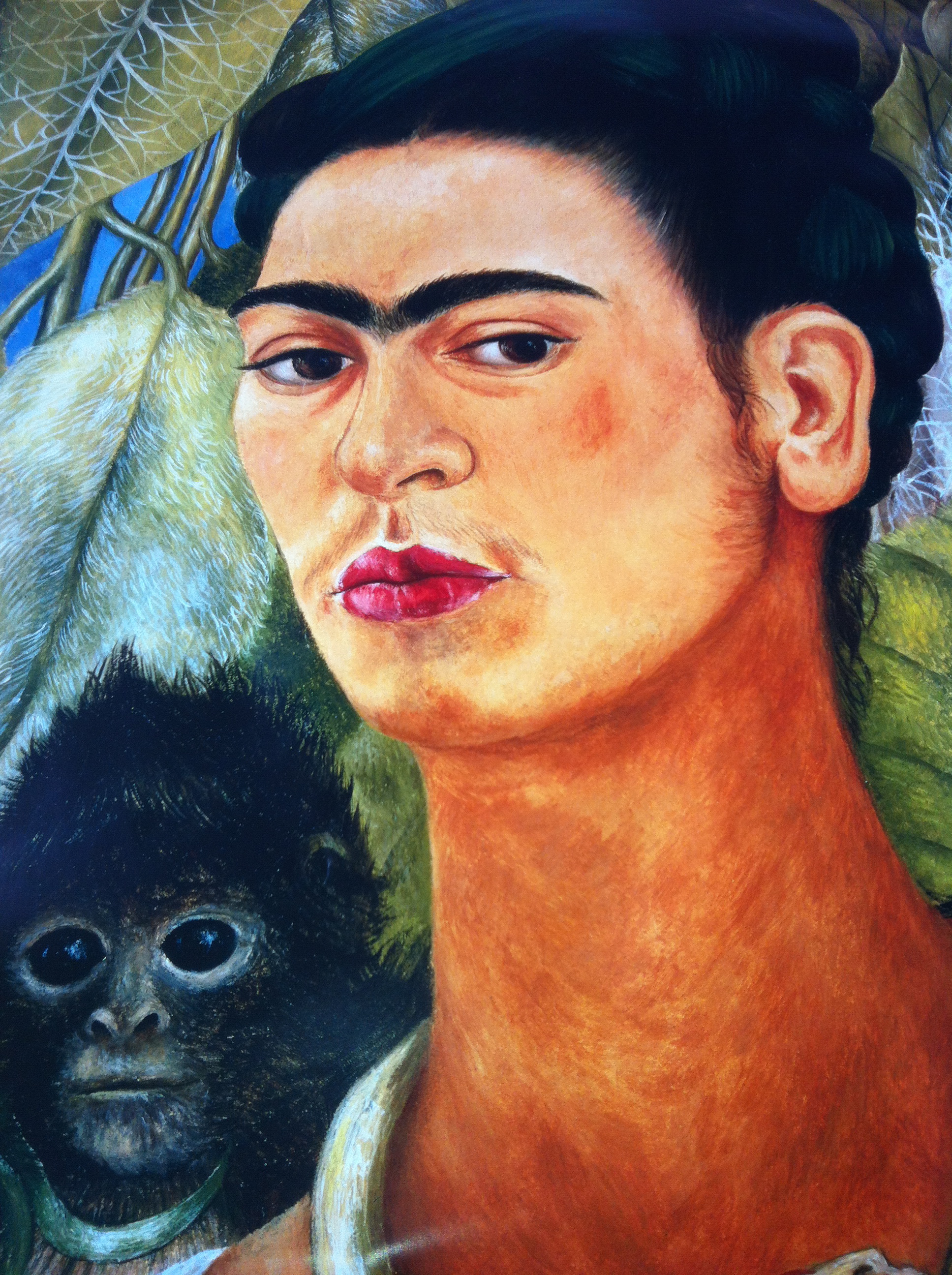
Frida - the poster I bought at the Tate Modern exhibition, 2005

On Wednesday evening, confined to the sofa with a blanket and hot water bottle by an annoying cold and driving rain, I watched the movie Frida, a biography of the Mexican artist Frida Kahlo. I’ve seen the film before but I’m still fascinated by the life story of the monobrowed feminist painter who suffered a crippling bus accident in her teens, had a turbulent marriage with Mexican muralist Diego Rivera, miscarried her only child, lost her right foot to gangrene and was confined to her bed before her death, aged 47. I’m not sure I’d want her paintings hanging around my flat – some of them are quite disturbing, haunting in fact – but they’re mesmorising in their intensity. I remember a Frida exhibition at the Tate Modern (it was 2005 – I’ve just found the poster I bought). I got the audio guide and spent hours listening to the story of her life and the sounds of Mexico.

Of course, Mexico holds a very special place in my heart and the film brought memories flooding back. I lived there from 1995 to 2000 – in my 20s – and I immersed myself in all things Mexican.

They were colourful and crazy years – just like the country and its capital city where I lived – but like so much of my life, they were mixed. What was happening on the outside – the partying, dancing and smiling – didn’t always reflect what was going on on the inside. The freedom wasn’t quite as it seemed.

I stumbled on Mexico. I’d been backpacking for about 18 months around Australia, New Zealand, Fiji and the States, interspersed with periods of living and working in various places to earn money (I waited tables in Sydney, picked fruit in Western Australia, washed dishes in Queenstown and made cardboard boxes in Auckland). But by the time I got to San Diego, I was feeling a little lost. Part of me wanted to come home but I wasn’t brave enough to give up my world tour without having achieved something or found what I was looking for, whatever that was. So I told myself I was heading to Colombia, where I had a university friend who might be able to find me some worthwhile work using my Spanish skills. I was going alone and travelling overland. First stop: Mexico.

My journey from the hectic border town of Tijuana to Mexico City – 1,428 miles – is a book in itself. Alone, lost and in search of a youth hostel in Tijuana, I was rescued by two Mexican brothers who took me home, cooked me meals and serenaded me on their guitars. I took the Copper Canyon railway, got off half-way across and sat on the roof of a bus, clinging on to the luggage, as it snaked its way down the canyon’s near-vertical slopes, the road’s bends adorned with makeshift shrines to those who’d miscalculated its curves. To get out of the canyon, I hitched alone in the dead of night (it was too hot for vehicles to make the long drive out in daylight) and got a lift with a Coca-Cola delivery truck.

My next ride was in the form of a tour bus – a Mexican ranchera (country music) band of a dozen men, complete with moustaches, beer bellies and sombreros. I slept at the back of the converted coach, spoke on the radio in a middle-of-nowhere Mexican town about my Liverpool roots and how the Beatles had supported my Dad’s jazz band in The Cavern, and made a hasty exit when the band’s manager – who’d invited me on the trip in the first place – started to get too friendly.

Arriving in Mexico City after a few more adventures, I got a room in a cheap hostel near the Zocalo and accepted an invite to drink tequila and dance salsa with a man I met on the street. He took me to Plaza Garibaldi – the home of the mariachi. Several hours later, I was drunk and sick and the man was suggesting a double room in a hotel. I thank God for getting me back to my dingy hostel alone and intact that night.

So it was a bumpy road to Mexico City but within a week or two I had a job as a reporter on an English-language newspaper, was sharing a flat with a bunch of gringos (the Mexican term for Americans) and had postponed my idea of getting to Colombia. As the months and years passed, I moved to a higher-quality paper and then to Bloomberg, acquired my first ever car – a Golf I bought in cash from a fellow journalist – and found a fantastic group of friends, Mexican, Spanish, American, British and several other nationalities.

If I take a superficial look back at those years, I see fun, travel, adventure, parties, amazing friendships and, most of all, freedom. I see the weekend trips in my Golf to Pie de la Cuesta, a beach haven not far from Acapulco with the wild Pacific Ocean on one side and a beautiful lagoon on the other. We’d water-ski on the lagoon, lie in hammocks on the beach drinking micheladas (beer, fresh lemon juice and salt around the rim of the glass – chilli is optional), and party at night in Acapulco. I see the trips to Oaxaca in the south, Veracruz in the east and the numerous visits to the pyramids of Teotihuacan. I see the nights out in Garibaldi – now safely ensconced within a group of friends rather than wandering around with a stranger – and the sunny days spent floating along the waterways of Xochimilco.

Looking back, life was so free. Money wasn’t a problem, friends were everywhere and Mexico was amazing – its history, culture, music, architecture and natural beauty. We’d fly to New York at the drop of a hat for some fun. And with work, I’d travel to Venezuela, Argentina and Colombia (finally making it to my initial destination but by air – I don’t think I’d ever worked out how I was going to get across the Darien Gap!)

But if I look a little deeper, the picture isn’t quite as rosy. I wasn’t as free as I seemed on the surface. A bit like Frida with her tortured paintings, often my insides were in turmoil. Yes, my adventurous spirit took me to some amazing places and I have a catalogue of experiences I’ll never forget. But I courted danger, took too many risks and I still think I’m lucky to be alive – and that’s without even mentioning the times I was robbed at gun and knife point.

I remember the tears in Tijuana when the two British guys I’d been travelling with for a few weeks headed back to San Diego to continue their tour of the States and I sat wondering what on earth I was doing in Mexico on my own. I remember calling my Dad to see if I’d been accepted onto a trainee scheme in Brussels I’d applied for. I hadn’t so I didn’t think I could go home – there was nothing to go home to and nothing to go home with. I had nothing to show for my travels except for a sun tan and a stack of photos.

I didn’t feel particularly safe in the home of the Mexican brothers, in the Coca-Cola truck with the two delivery men or packed onto a tour bus with a bunch of Mexican musicians. I’m horrified when I think of all the times I drove drunk, my car packed with friends either slumped in sleep or singing Luis Miguel ballads. And I’m sad about what I put my body through for so many years.

We’d party most nights, but especially on Thursdays. We’d drink and dance until dawn, I’d race home to get changed and then head straight to my serious job at Bloomberg. I’d often throw up in the toilets at work and binge on food throughout the day to get me through. Friday was a big night out too and on Saturday morning, I’d leave my boyfriend sleeping off the tequila and I’d head to the gym for a step class, hungover and after just a few hours sleep. I’d feel sick and dizzy but I was obsessed with staying thin and keeping active. I was in perpetual motion. I couldn’t relax and I had little interest in looking after my health.

I remember the insecurities, never feeling pretty enough or thin enough. The visits to the Mexican doctor and the diet pills (akin to Speed) he gave me despite the fact I may have only been a stone overweight. The reckless behaviour – the phrase “sex, drugs and rock ‘n’ roll” just about covers it – because I felt I had something to prove or I didn’t feel good enough and wanted to feel loved or I needed to be on a permanent high because I was scared to discover the fear and pain that lay underneath.

The dismantling of that outwardly confident, ever-smiling personality I built up and the tearing down of the walls of pretense has been a slow process. It began in my early 30s in Brazil (where I lived for 2 1/2 years after Mexico) as I began to realise my overeating, excessive drinking and overdoing were covering up painful emotions that dated back to my childhood years. It accelerated when I finally allowed myself to come home in 2002. At last I had something to show for my travels and could return to the UK, I felt, ‘in triumph’ – as a parliamentary correspondent for Reuters, based in the House of Commons. Of course, I’m sure my family wouldn’t have cared if I’d have returned penniless and unemployed. I’m the one who cared, although my early family experiences had, in part, formed my nature, given me my pride and driven me to achieve.

Years on, that process of dismantling and rebuilding myself is still underway. Many of the obviously unhealthy behaviours have gone but the more subtle ones are still there. I’m still playing a game with myself, hiding from my true self, burying myself. I get many glimpses of the real me – often through my writing on this blog or through my sports – but I’m still afraid to let her fly.

And I’m still trying to understand fear and courage. I can jump off bridges with a bungee cord around my waist, hurl myself out of a plane with a parachute on my back and hitchhike alone on deserted highways. I can speak to presidents and prime ministers or to rooms full of strangers. But having the courage to be me is a whole different story. I’m often reminded of that expression: ‘will the real me please stand up’. I’d say I’m half-way to standing point, still crouched but, thank God, no longer seated.

I guess that’s why I’m so fascinated by Frida and her paintings. She doesn’t hold back. There’s no disguising her pain. It’s splashed in vivid colours across a canvas: from her despair around her miscarriage to her frustration with her broken body to her fiery relationship with her unfaithful husband.

I was thinking of the bright blues, greens and yellows of Frida’s paintings yesterday as I travelled through East London on the tube. It was grey and rainy outside and I was surrounded by soggy feet, dripping umbrellas and miserable faces. Mexico, I thought. The light and life. The colours, smells and flavours. The road trips to Acapulco. The sea, the sand, the sun. The mariachi bands at Garibaldi and Xochimilco. The freedom (at least on the outside). So why did I leave? Why am I living under these grey skies? Why don’t I go back?

I guess the answer is that to find myself I had to come home, to where it all began. And as I’m still finding myself, it’s probably best I stay put.

Posted in Addiction, Eating disorders, Fun, Recovery, Self-Acceptance, Travel, Uncategorized, Women | Tagged , , , , , | 6 Comments

Operation Happiness

I wrote in a previous blog post that I was going to explain more about my Operation Happiness plan but I got sidetracked by the Samantha Brick saga (see my previous post if you’ve never heard of her!), which, after a quick glance at some news sites, is still going strong – it seems she might be paid large sums of money to go on Celebrity Big Brother.

While the story has blown over for me, I still think it sparked interesting debate and it certainly got me thinking about my own relationship with my looks, where, it seems, there’s still room for improvement. Predictably, as I watched back the episode of Boulton and Co on Sky News on which I was invited to talk about beauty and Samantha Brick (Thursday April 5 if you have Sky – I can’t find a link that’s free), I cringed at the sight of myself on TV. I thought I looked fat and unattractive, as well as overly made-up and wished I’d chosen different clothes. And does my mouth really move in that odd way when I talk?

So there I am, on TV, talking about the importance of celebrating our uniqueness and loving the way we look. And then, a day later, I’m sitting on the sofa, watching it back, and berating myself for looking like I do. The irony hasn’t escaped me – I’m aware I’m a walking contradiction! But the good thing is that I am aware of it. Unfortunately, my negative thinking and that hyper-critical voice in the back of my head are pretty powerful – after all, they’ve been given free rein for many years – and it’s going to take a good deal of effort to challenge those thoughts and replace them with healthier ones. The interesting thing is that nobody else gets the hard time I often give to myself. I tell my friends they’re beautiful, courageous, stylish, talented, witty etc but I can’t remember when I last used those words to describe myself. I could definitely do with an injection of Samantha Brick-style confidence, although I don’t think Celebrity Big Brother is for me.

So back to Operation Happiness, which could also be called Operation Freedom, since for me, freedom from negative thinking and from emotional turmoil and freedom to live the life I want to live and not the one I think I ought to are the route to happiness.

I decided at my 41st birthday that there was something missing in my life – something important for my happiness – and I’m doing my best to resolve that. As I sent out invitations to my karaoke party, I realised I was inviting work friends, church friends and friends I’ve met over the years on my addiction recovery journey. But there were no ‘hobby’ friends. I’ve toyed with hobbies in recent months as this blog will attest – singing being one – but nothing had stuck. So I asked myself that question that life coaches and self-help books universally recommend: what made me happiest as a child? The answer was team sport – sociable, competitive, team sport in the great outdoors.

I always loved team sport at school and university but I dropped it once I began travelling and living abroad. I worked hard, partied hard and did my exercise in the gym or ran on my own. I joined in with great enthusiasm whenever there was the chance to play football or rounders at a picnic or a work gathering but there was nothing regular. It’s sad to think I spent so many years not doing something that makes me very happy.

But now I’ve identified what’s missing, I’m doing something about it, even if I’m not as young and fit as I used to be and various parts of my body ache due to injury and misuse. I’ve been to Ultimate Frisbee in my local park – taking advantage of the fact that I grew up with a brother and can throw reasonably well. I’ve signed up to play doubles tennis socially also in the park. And I’m on the lookout for a mixed softball team that’ll bear with me as I try to convert my schoolgirl rounders skills to softball.

Now, as you’ll see, I’ve gone a little overboard. I was supposed to be finding a team sport and I’ve pretty much signed up for three. As my Mum always says, I never do anything by halves. But I see this as an exploratory stage and hopefully one of them will stick, or rather I’ll stick to at least one of them. I’m discovering it’s a lot easier to exercise after work if there’s a fun team sport going on in my local park.

Another element of Operation Happiness involves weekend activities in the great British countryside, preferably with bicycles, tents and, if possible, live music. I was never really into the British music festival scene. After all, I spent my 20s and early 30s – those key music festival-going years – living abroad. But I went to two last spring and summer and I hope to go to more this year. I’m talking about the smaller festivals. Although Glastonbury sounds amazing, I’m not sure I’m up for that degree of revelry and mud.

I began my festival-going year last weekend with a return visit to Wiltshire and to Onefest, which I went to last April when it was in its first year and called Honeyfest. Last year’s trip gave rise to the blog ‘Do more of what you love‘ and reminded me how much I enjoy camping, cycling and listening to live music in a field. Re-reading that blog post is really interesting. I can see how I still struggle with some of the same issues but I can also see a slight shift in my thinking. Last year, I came close to cancelling the trip because I was overwhelmed with work, exhausted and worried about the cold. The same thought crossed my mind on Friday evening for similar reasons but it was fleeting and I soon banished it from my mind. I was going, irrespective of my tiredness or the weather. I’d learned the previous year that getting me to my destination would require effort but that effort was well worth making.

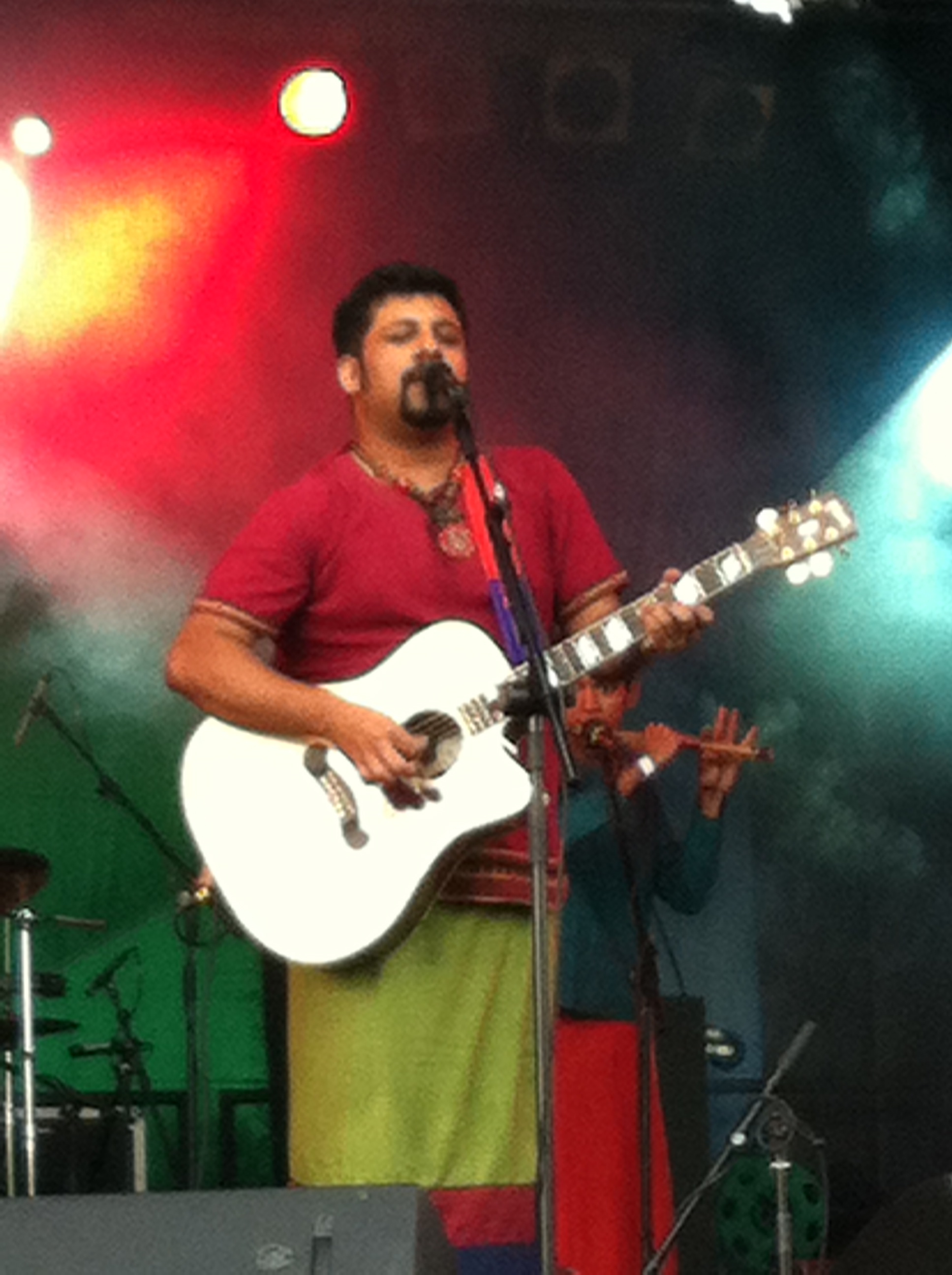
Raghu Dixit performing at Onefest

This year was a different experience but just as rewarding. There’s something so refreshing about standing in a muddy field listening to live music, barn dancing with friends and strangers to the sound of a fiddle in a marquee and eating pie, mushy peas and gravy out of a cardboard box. And as if all that wasn’t therapeutic enough, Raghu Dixit performed his own special brand of Indian-folk fusion while sharing his ‘don’t worry, be happy’ philosophy on life with the crowd. You can hear some of his music here.

Camping, too, was a different experience to last April when we all froze. As we pitched our tents on Saturday afternoon, a friend realised her sister lived twenty minutes away in a three-bedroom house so we unpitched the tents at the end of the night and slept indoors! I do love camping, but not so much when the temperature is minus 1. And there are plenty of summer months ahead to sleep under canvas.

I returned to London late on Sunday – after a long walk, a pub lunch and a slow train – and very tired. Despite the comfort of the double bed and duvet, my overactive brain had kept me a wake a lot of the night and I hadn’t had much sleep the week before. But it was worth the tiredness to get out into the countryside with friends and music. And I’d say it generally always is.

Posted in Body Image, Fun, Leisure, Self-Acceptance, Uncategorized, Women | Tagged , , , , | Leave a comment

Beauty and the Brick

I’m not sure how many of you have followed the Samantha Brick saga, otherwise known as Brick-gate or, as I’ve decided to rename it, Beauty and the Brick. She’s a 41-year-old woman who wrote a piece for Femail, the Daily Mail’s women’s pages (where I’ve appeared a few times this year), talking about how women envied her beauty and men showered her with compliments and gifts. The original story is here, but if you want to know what all the fuss is about, it’s best to read her second-day article, or the latest piece on the woman who has become an Internet sensation. And there are countless stories about Samantha Brick and the reaction to her all over the Web (including this talking brick on YouTube).

Now, if you’re not interested in Brick-gate or if you think clicking on these links is feeding an unhealthy, divisive debate or turning a non-story into a story, I totally respect that. There’s part of me that feels the same. But having read some of the comments and Tweets in response to her original piece, I thought the furore raised some interesting points. So I waded in yesterday with my personal take on the saga on the Huffington Post: Whatever you think of Samantha Brick, it’s time we women start celebrating our beauty.

And I’ve just come back from being interviewed on Sky News, on the Boulton and Co programme (I’ll post a link when I find one), about the saga.

In summary, while I accept some of her comments were divisive, probably deliberately so, and I don’t agree with the tone of the article that seems to pit women against each other, I felt the barrage of criticism hurled at Samantha Brick specifically about her looks (“you’re ugly, you’re deluded, you need glasses, your facial features aren’t symmetrical” etc) proves that a rigid concept of beauty is still alive and kicking and that anyone who doesn’t meet that but still thinks they’re attractive is deluded. In other words, we’re only allowed to say we’re beautiful if we look a certain way.

And the response to her article also reminded me that we women are often our own worst enemies. We criticise ourselves and we criticise each other. We slate our looks, the size and shape of our bodies, our hair and our skin tone. We poke and prod at ourselves and, in more extreme cases that are sadly becoming the norm, we have parts of ourselves surgically changed or enhanced. It’s a shame more of us can’t declare our beauty, whatever we look like, to ourselves and to others. It seems it’s a cultural taboo – akin to big-headedness or boasting. I don’t think I’ve ever heard a friend say, “I look great in this dress”. More likely, she’ll be pointing out how it’s a little tight around the waist or the fact her upper arms aren’t toned enough to be on show (I know I would be).

The point I wanted to make on Sky, which I may not have got across as eloquently as I’d have liked (that’s live television for you), is that Samantha Brick does have a point: I do think women who are insecure about their own looks can feel threatened by women they deem to be more beautiful. I know this from my own experience.

But the answer isn’t to rip the beautiful ones to shreds, to dislike them, envy them or exclude them from our circle. The answer is to focus on ourselves and to build our own confidence in our looks so that we don’t feel so intimidated by others. We can’t change the way we look or the way others look (without expensive surgery), but we can change the way we feel about ourselves and how we relate to others. If we’re comfortable in our own skin, accept the way we look and rejoice in our own beautiful uniqueness, we’ll be more able to celebrate the beauty of those around us.

I admit I’m one of the worst offenders when it comes to this kind of insecurity. Despite my self-acceptance challenge in Lent last year and continued efforts to embrace my looks, I still struggle to do so. And of course, when I watch back the Boulton and Co programme, I’ll be scrutinising myself to see if my face looks puffy, my hair looks a mess or if I need to lose a few pounds, as much as I’ll be judging myself on whether my arguments were coherent and intelligent.

But the good thing is at least today I’m aware of how my mind works. The side of me that envies other women’s attractiveness and belittles my own is a very young part of me – it’s the little girl inside me who thinks there isn’t enough love to go around. She thinks she’ll be neglected or abandoned if she’s not pretty enough or good enough, a fear that’s exacerbated, and understandably, by the presence of beautiful girls. But I now know I don’t have to react to those thoughts or allow them free rein. I just need to reassure myself that I’m OK, exactly as I am, and that there’s enough love to go around for all of us, no matter what we look like.

Posted in Addiction, Body Image, Eating disorders, Perfectionism, Self-Acceptance, Uncategorized, Women | Tagged , , , , , | Leave a comment

Is achievement overrated?

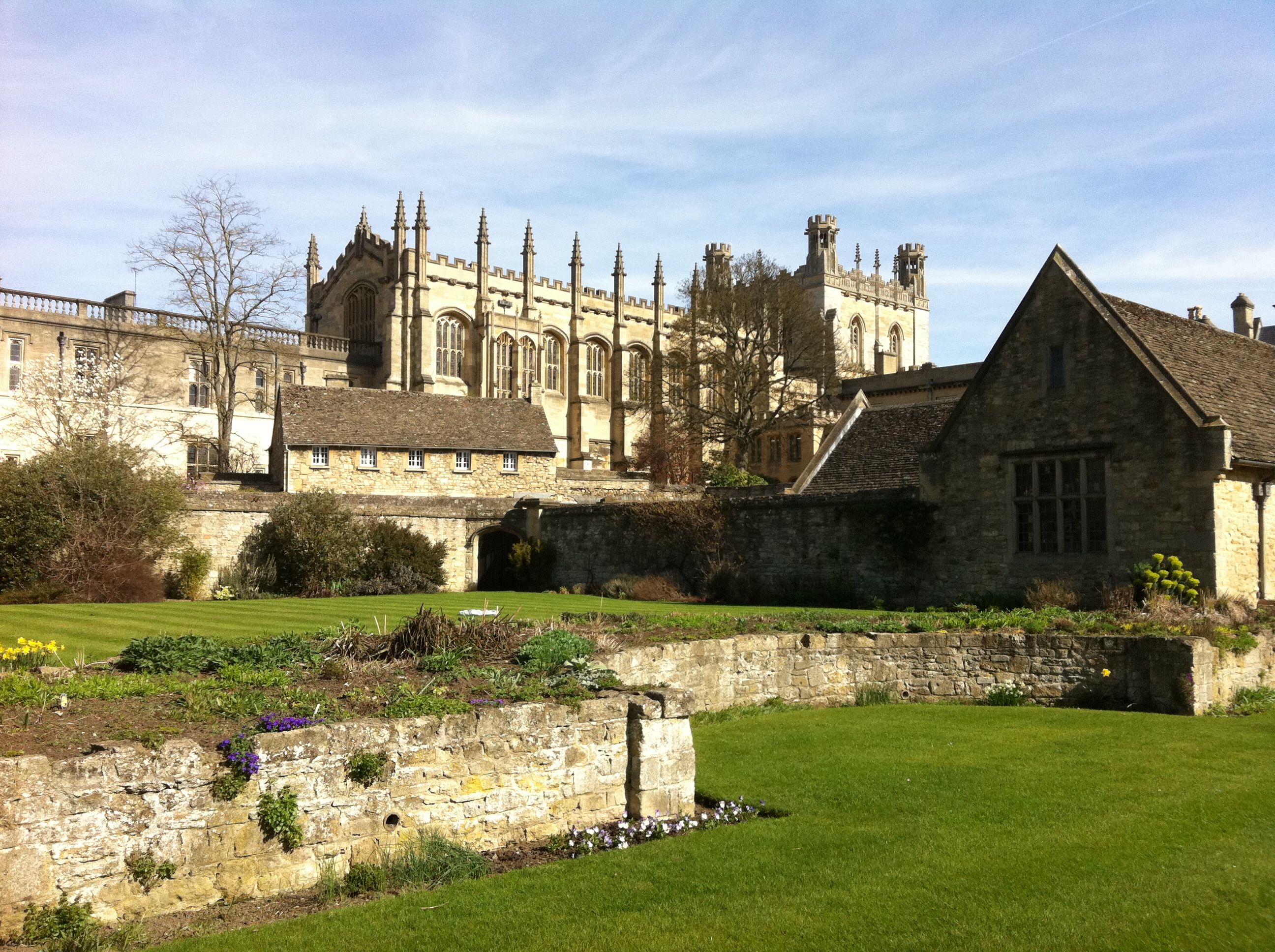
The weekend before last, I took a stroll down memory lane. I went back to Oxford University, where I was a student from 1989 to 1993, for a reunion dinner at my college (St Anne’s) and to spend a sunny weekend in what is an incredibly beautiful city.

I knew it would be a lovely few days in terms of sunshine, scenery and seeing old friends but I was also apprehensive. Firstly, I imagined all my fellow alumni would be “sorted”, in life, love and work. That they’d all be sure of what they were doing and where they were going and would be combining impressive careers with bringing up children in detached homes. I thought I’d be the only one who was pondering which way to turn in her work life, who wasn’t settled with a partner and family and who sometimes struggled to be happy.

I also expected the weekend would be emotionally challenging. I imagined I’d recall the negative aspects of those university days – my low self-esteem and painful self-consciousness, the binge eating and binge drinking, the several stone extra in weight I was carrying and my dislike for my body.

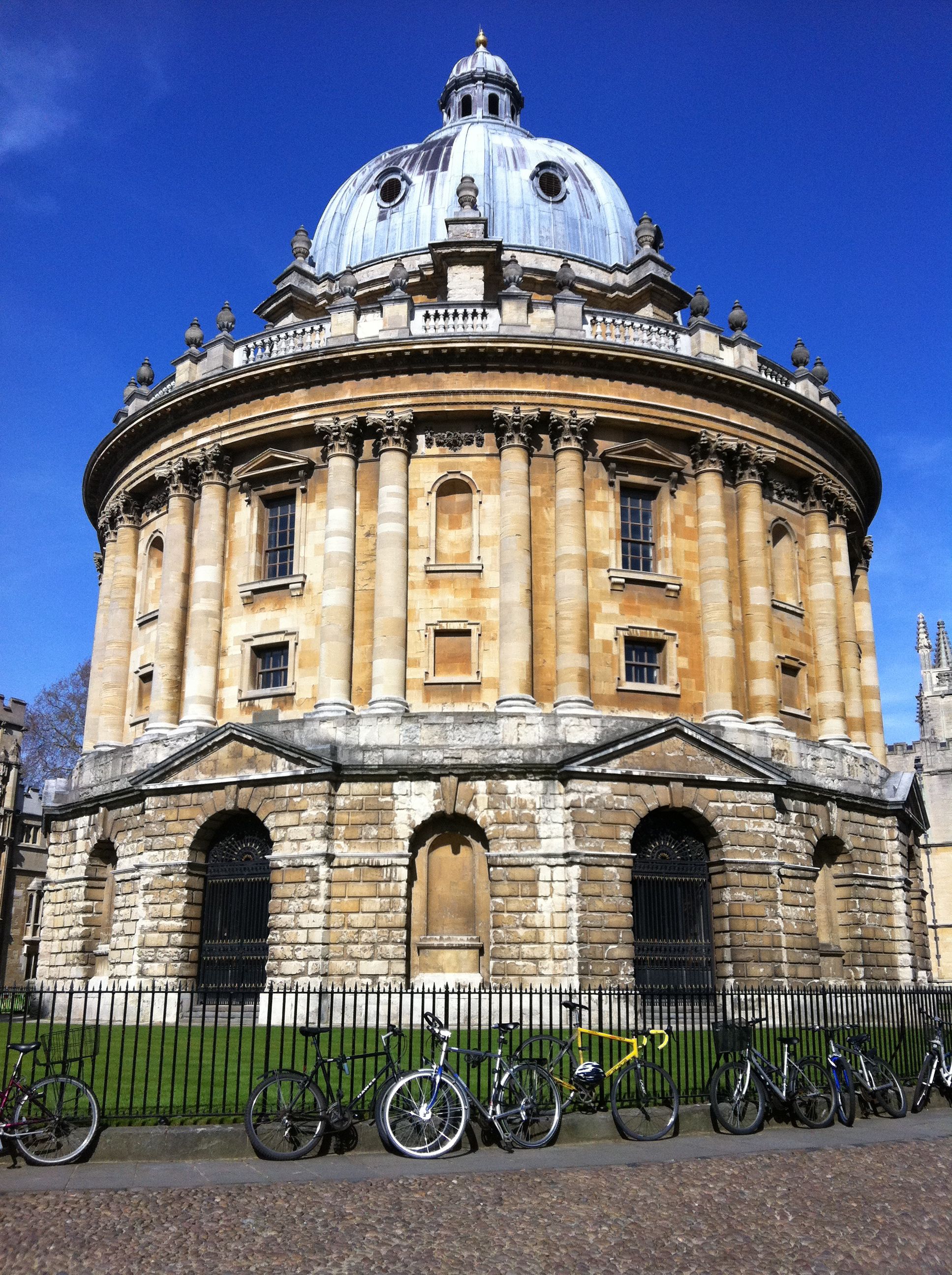
The Bodleian Library

University is supposed to be the best years of your life, a time of exploration, freedom, friendship and broadening one’s horizons. And I was at Oxford, not only an incredible seat of learning but a place of privilege in terms of social and sporting facilities. But when I look back at photos of those years, I cringe. I see a woman who was lacking in self-belief and self-confidence and who overate to blot out painful feelings; a woman who felt less than her fellow students – physically, intellectually and financially.

I came to Oxford from a single-parent home in Liverpool. I was the first member of my family to go to university and I’d never eaten an avocado. I remember wishing I had the money to buy the nice clothes some of my new student friends were wearing or the confidence to pull them off. I recall wishing my parents lived in Hong Kong or Africa, that my Dad was a diplomat or that my family debated current affairs around a dinner table of homemade curries or avocado salads – in my house, we ate off trays on our knees while watching TV.

This isn’t meant to sound like a sob story. I didn’t arrive at Oxford dressed in rags and I’d had a great education at a private girls’ school (thanks to a scholarship) where I’d been head girl and captain of various sports teams. But arriving at university was quite a shock. Most of the students had also been head girls or boys and had excelled at sports and studies. Not only that, but they seemed to be oozing with self-confidence and many – of course, not all – seemed to have stability, security and money behind them.

Looking back, I now see that my outer achievements at school and in sports were just that, outer achievements. I’d pushed myself academically and physically, with great results. But my success was built on sand. I had no sense of security or self-esteem, no sense of who I was or why I was trying so hard and no grounding. And I was hypersensitive to rejection. So when, in my early days at St Anne’s, I wasn’t invited to a cocktail party with students I thought were becoming my friends or when I went to the university lacrosse trials and felt ignored by a coach who in my eyes favoured the confident, blonde, southern girls, I crumbled. I didn’t have the inner strength to tell myself I was good enough just as I was.

Against that backdrop, the compulsive behaviours I’d discovered in my school years to anaesthetise my feelings ran wild. I overate and then tried to compensate by going on long, punishing runs. I drank to excess (granted, a typical student activity). And I didn’t date – except for during holidays and my final year when I was thinner and felt more confident – preferring to obsess in my head about men who weren’t interested in me.

With all that in mind, I thought my return to Oxford would be a sad affair, albeit a cathartic one. But while I feel rather subdued writing down some of those memories, my weekend walk down memory lane was completely different to what I’d expected.

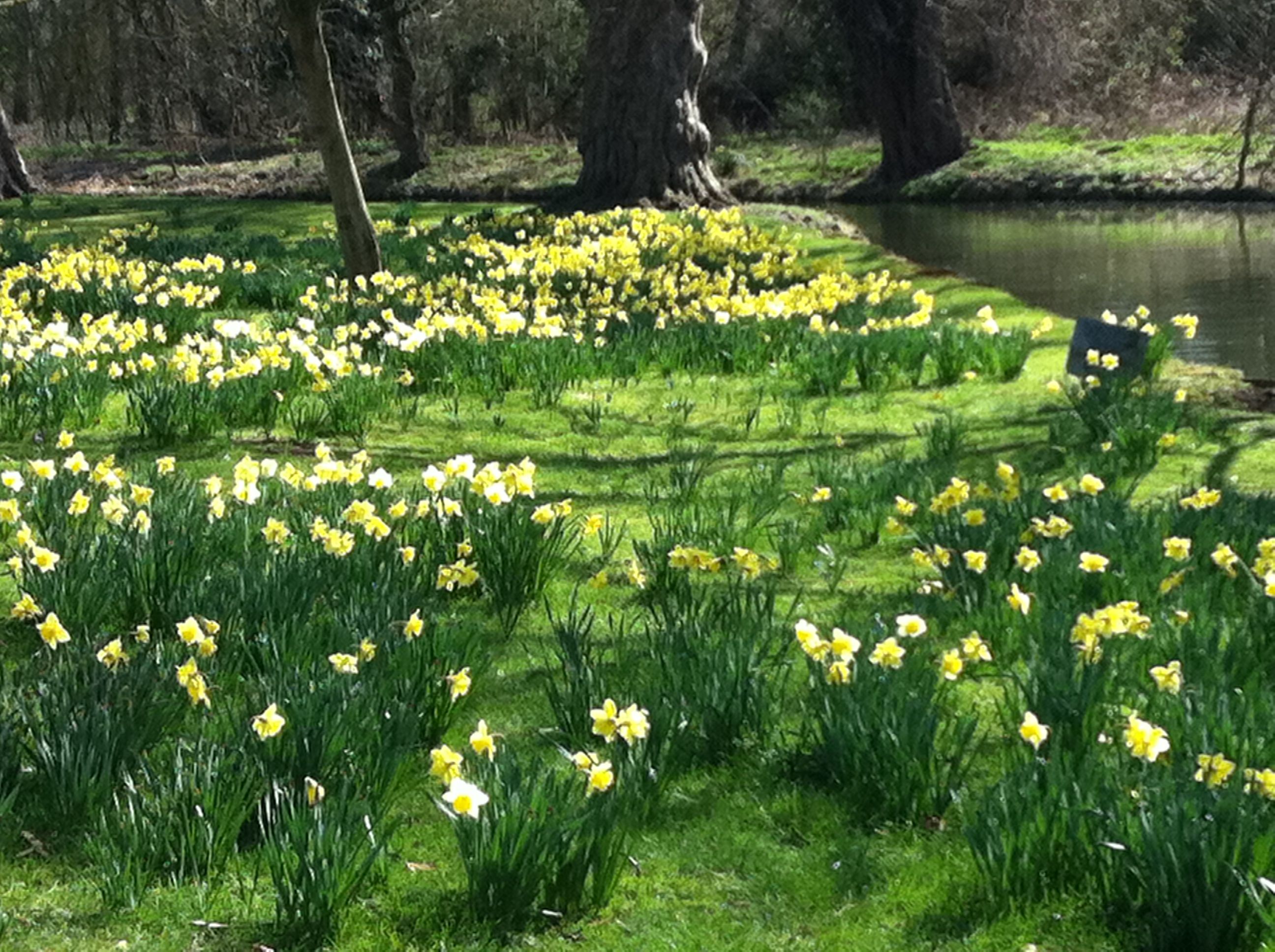
Daffodils by the river

Rather than confronting my demons, I spent most of the weekend reminiscing about the good times. The city looked beautiful, with its spires, daffodil-filled parks, rivers and bicycles. I remembered the picnics, the parties, the punting and the fun I had rowing in eights with my college friends. And I realised – probably for the first time – what an incredible privilege it had been to study there.

I hadn’t wanted to go to Oxford. I applied because my school suggested I could get in and because I thought it was expected of me. I sobbed when the acceptance letter came through the post. I wanted to go to Edinburgh or Newcastle or somewhere more “normal”. I thought Oxford would be filled with posh, clever, rich people (and it was, in part, but some of those people became my best friends and others came from more simple backgrounds like me). I could have turned down my place – my family gave me the choice. But, perhaps because I thought I ought to or because I recognised a good opportunity, I accepted it.

How different would things have been if I’d heeded my tears and gone elsewhere? I’ll never know.

But what’s comforting is to realise I’m not that different to my fellow alumni after all. Not everyone I met at the reunion was “sorted” – yes, there were some tales of happy families and flourishing careers but others were single or getting divorced and many were at a career crossroads, wondering what to do with their lives or in a job they felt they had to stay in for the money and security.

And, I finally realised, nor was I that different to my fellows back in my university days. Yes, there were the confident ones who seemed so sure of themselves but like me, many were riddled with insecurities and drank or ate too much to take the edge off. So my trip back had been cathartic, but not in the way I’d expected.

But as I was leaving college on the Sunday, something caught my eye. It was a ‘wall of fame’ of those who’d studied at St Anne’s and gone on to achieve great things. A few names stood out. I’d never known, for example, that Helen Fielding, the hugely successful author of Bridget Jones’ diary had gone to my college. I re-read Bridget Jones recently, looking for some inspiration for my own ‘From Forty With Love’ book, and was reminded how brilliantly written and observed it is, in the humble opinion of this London singleton. Other alumni included Jackie Ashley, Zoë Heller, Martha Kearney and Tina Brown, all well-known, successful journalists, writers or broadcasters.

What struck me, however, as I read down the list of names, was that it was all about achievement at work. Only those who’d gained notoriety, who were in the public eye, who had written best-sellers or had done great things in science or the Arts got a mention.

But what about happiness? What about inner peace and contentment? What about fulfilment, love or family? I’d have been just as interested to know whether everyone on the list had found happiness alongside their success, whether they felt content, settled, secure and loved. Or had fame and fortune left them feeling empty? Were they constantly striving and not feeling good enough? Had they prioritised career over happiness and ended up disillusioned? Helen Fielding spoke at the Oxford Union in 2009 about the pressure on women to do it all and have it all and, although you can’t believe everything you read in the papers, it seems the private lives of great achievers haven’t always been a bed of roses.

And where were the names of those students who hadn’t achieved notoriety but were happily working, living and loving, who’d found peace or were in a solid marriage and providing stability for their children? Surely, they deserve a mention on the wall of fame.

This may all sound a little naive. After all, if none of us felt driven or inspired to write, broadcast, experiment in science, practice law at the highest level and so on, there’d be little development and the world would be a very dull place. And it’s unlikely Oxford University would ever broadcast the happiness of its alumni over their achievements.

But I ponder these things because of my own experience. Achieving things because we think we’re supposed to or it’s expected of us or because we’re driven by insecurity and a compulsive desire to be seen or heard, does not bring happiness or contentment. We get what we always thought we wanted and we wonder why we wanted it in the first place. And then we realise that we never really knew what we wanted because we never knew ourselves. We’d hidden ourselves or lost ourselves amid all the striving to be what others wanted us to be. Or we’d tried to mask our deep insecurities or feelings of not being good enough with external accolades, while worrying one day that we’d get found out. Of course, this isn’t the case for everyone but it was, in part at least, the case for me.

And that’s why, for the time being, I’m resigning from the mission of trying to work out what to do with my life or what it is I’m supposed to achieve and I’m embracing a new challenge: Operation Happiness. More about that in my next post.

Oxford - A privilege

Posted in Addiction, Eating disorders, Self-Acceptance, Women, Work | 8 Comments

The karaoke cure

A few weeks ago, I posted on my Facebook page that I’d discovered a cure for the blues, depression, anxiety, stress and all other ills: The Muppets Movie (if you’re in need of an instant pick-me-up, I highly recommend you watch this clip). And on Saturday night, I discovered another cure: Karaoke. Give a bunch of women (and a few brave men) a couple of microphones and you’re in for a long, noisy and hilarious night.

I held a karaoke party for my 41st birthday and any remnants of the glumness I talked about in my last post disappeared as I listened to myself and my dearest friends (several of them single and in their forties) sing our hearts out while dancing around as though we were in the latest girl band. Suddenly, the Mark Twain quote written on another birthday card I received came into its own: “Sing like no one’s listening, love like you’re never been hurt, dance like nobody’s watching and live like it’s heaven on earth.” I don’t know about anyone else, but I was definitely singing like no one was listening. I must get back to those singing lessons. And while I ended up with a very sore throat afterwards, it was one of those feel-good evenings when you look around at all your friends, giggle to yourself and feel incredibly grateful.

Happiness is ...

Aside from The Muppets and karaoke, there are a few other cures for the blues I’ve discovered since I was hit with a brief spell of age-related sadness on my 41st birthday morning: stop comparing myself with others or thinking that the grass is always greener and get down on my knees every morning to thank God for all my blessings and another day filled with possibilities. As long as I remember to do all of the above, I’m guaranteed a pretty good day.

One thing that really got me thinking since my last post was a response I received from a fellow 41-year-old woman I met recently whose circumstances are completely different to mine, but whose feelings are much the same. She shared that she had all the things I thought I’d have by this age: the home, the garden, the partner, the children, the pets, the latest fashions and an array of baking tins. She’s also had career success and now has the freedom that comes from working for herself. But she still feels empty and lonely at times and struggles to appreciate everything she has. She feels like she’s never working hard enough or doing enough for her business and she definitely doesn’t feel like a grown-up, despite being responsible for small people ie. children. She still feels dissatisfied and feels she hasn’t lived up to the expectations she had for her life. I’m really grateful for her openness and honesty and her comments have reminded me that there’s no easy or external fix for that sense of inner dissatisfaction or incompleteness that I sometimes feel. Having what we always thought we’d wanted will not suddenly change the way we feel on the inside. As I’ve written before, happiness is an inside-out job, not outside-in. If we can learn to be content whatever our circumstances, we’ll be more able to enjoy the present.

On the topic of happiness, a friend bought me The Happiness Project for my birthday, a book by Gretchen Rubin that’s also given rise to a website of the same name. I’ve only just started reading it but I’m really enjoying it. So far, I haven’t come across anything I haven’t heard before or don’t already know – I’ve read that adequate rest, sleep and exercise all improve our mood – but it’s good to be reminded that there are so many simple things we can do to change how we feel. I also just spotted something on her website that I could really relate to and it’s good to hear it from such a successful author. She was describing how she’d just received the preview copy of her latest book and while she felt thrilled, she also panicked and couldn’t bring herself to open it. She goes on to say:

I get the same feeling when I have a piece run in a newspaper or magazine. Most writers seem to love the moment when they see their work “in print,” but not me. I’m not really sure why. Am I afraid of spotting a mistake? Or seeing something that, by this point, I’d do differently? Maybe. Do you ever experience that? Something that seems to make other people wildly happy—that you think “should” make you happy—for some reason, doesn’t?

I’ve definitely had that experience with stories I’ve published. There’s been positive feedback and praise but I’ve been scared to look at them and struggled to accept them as being good enough or to get any real satisfaction from them.

This reminds me of something I heard at the Women of the World Festival last weekend. Comedian Angie Le Mar, speaking on a panel called Crash and Burn that was about mental breakdown or hitting the wall, shared how she’d leave a show after making the entire audience laugh and receiving endless praise, but she’d feel empty inside. What was making everyone else happy wasn’t making her happy. It was a moment of awakening when she realised happiness and fulfilment had to come from the inside. I was touched by what she shared and by Ruby Wax’s story of her depression, which she shared on the same panel. You can read about Ruby’s experience and about her mental health show Live from the Priory, which I saw her perform at the festival and absolutely loved, in this Guardian piece: Ruby Wax, depression, me and you.

Before I sign off, I came across an article the other day about a new stage show that discusses the impact of alcohol on women, which sounds both funny and moving. If you’ll recall, I blogged a few weeks back about my own lucky escapes from dangerous drunken situations. The play is called Thirsty and is performed by The Paper Birds and there was a write-up of it last week in The Guardian.

Have a happy day.

Posted in Fun, Happiness, Women | Tagged , , , , , , , , | 4 Comments